Church Accounting Software: A Complete Guide
Church accounting software tracks tithes, designated funds, donor receipts, and department budgets, things generic software was never designed to handle. This guide covers what features actually matter and what to look for before committing to anything.
What Is Church Accounting Software?
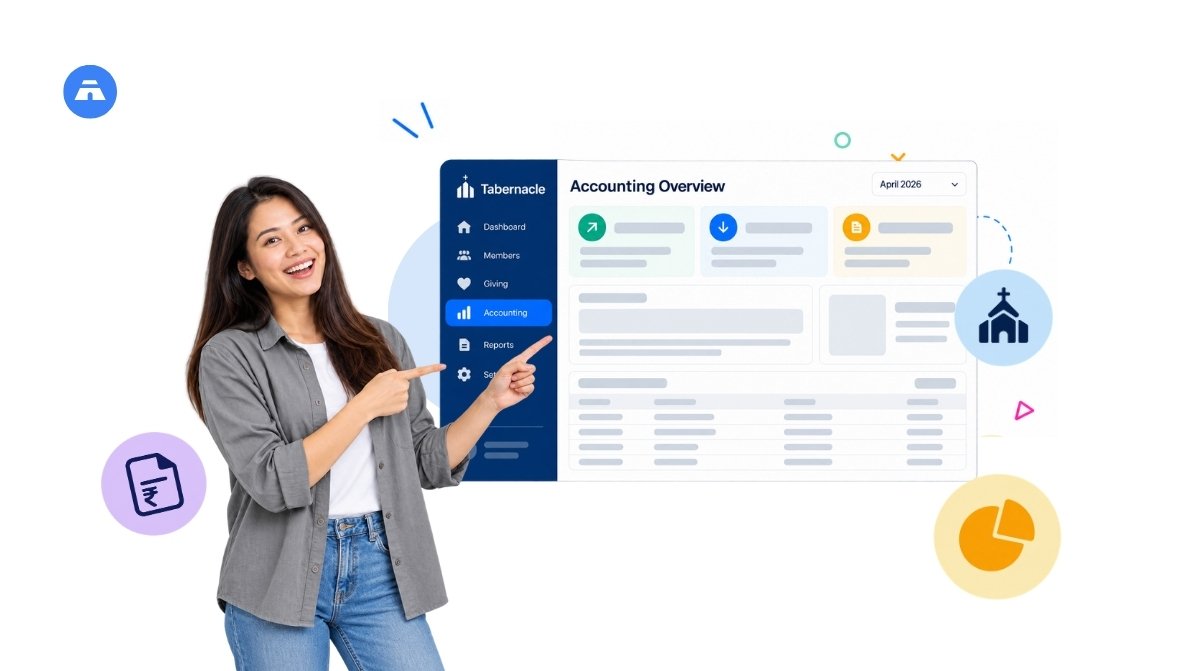
Church accounting software is financial software built for how churches handle money - not how businesses do. Unlike other accounting tools, it tracks tithes, designated donations, and separate funds, so a gift given for one purpose never ends up covering another. It also handles the things churches actually need: donor receipts, budget tracking by department, and financial reports that make sense to a pastor, not just an accountant.
Most churches find this out six months too late: church accounting software and business accounting software are not the same thing with a different logo. The gap is wide. And the churches that try to bridge it with QuickBooks or Tally tend to spend more time managing workarounds than managing their finances.
We've onboarded churches that spent two years in Excel before switching. The ones that struggle most aren't small, they're the ones where one person built a system only they understand, and that system is now the single point of failure for the entire congregation's financial memory. This guide is a distillation of what we've learned working with churches across Nagaland, Mizoram, West Bengal, and beyond.
Why Generic Accounting Software Fails Churches
Talk to any church treasurer who has spent a year trying to make QuickBooks work for a congregation and you will hear the same frustrations. The problems are not random. They are structural.
-
QuickBooks talks about invoices, clients, and revenue. A church has none of those. You can rename the fields - plenty of treasurers do - but every renamed field is something someone has to remember to use correctly, forever.
-
Tally is built for GST-compliant business transactions. It has no idea what a tithe is, or what it means when a donor says their gift is for the building fund and nowhere else.
-
The reports don't answer church questions. A profit and loss statement is useless to a board asking whether Sunday offerings were down last month or whether 80G receipts have gone out to donors before tax season.
-
Fund accounting isn't there. Generic software treats all money as one pool. That's fine for a shop. For a church tracking five or six designated funds, it's where the real problems quietly build up.

According to the 2024 Give.org Donor Trust Report, 67% of donors say it is highly important to trust a charity before giving - yet only 22% say they actually have high trust in the charities they support. Generic software can record transactions. It cannot produce clear, readable reports that close that gap.
Launch your church into the future
Everything your ministry needs — giving, events, members, and more. Try it free, no credit card required.
Start Free Trial No credit card • Cancel anytimeChurch Accounting vs Nonprofit Accounting - What's the Difference?
Most people assume church accounting is just nonprofit accounting with different branding. It's similar in principle, but the day-to-day reality is quite different.
Nonprofit accounting - whether under FASB standards in the US, the Charities Act in the UK, or the Companies Act for registered societies in India - focuses on net assets, fund restrictions, and accountability to donors and regulators. Churches work within those same principles. What's different is the fund structure. A nonprofit running a literacy programe typically has one primary mission and one or two funds to track. A church is managing a building fund, a missions fund, a women's ministry budget, a youth department allocation, and a general operating pool all at once, each with its own accountability expectations. Donations from a special Sunday drive often carry donor expectations that act like restrictions even when nothing was written down.
Then there's who's actually doing the books. Most nonprofits have a paid finance person with some accounting background. Most church treasurers are volunteers with full-time jobs elsewhere, doing this on weeknights and Sunday afternoons. That gap matters more than people realised - software built for nonprofit finance teams tends to assume a certain baseline that most church volunteers don't have and shouldn't need.
| Nonprofit Software | Church Accounting Software | |
| Designed for | Program expenses and net assets | Fund stewardship across multiple designated giving pools |
| Fund structure | One or two primary mission areas | Several simultaneous funds, each with separate accountability |
| Who uses it | Paid finance staff | Volunteer treasurer, often without accounting training |
| Compliance | Varies by country and registration type | Local tax exemption, donor receipts, giving statements |
| Who reads the reports | Board and regulators | Pastor, board, and the broader congregation |
The Basic Features Every Churches Needs
Not all church accounting software is created equally. Some are accounting-heavy with thin membership tools. Others are the reverse. Here is what the financial side actually needs to do.
Note: Church bookkeeping and standard bookkeeping use the same basic discipline - record every transaction, keep it in the right category, don't mix things up. What's different is the structure underneath. Churches use fund-based categories rather than profit-and-loss ones, and the reports leadership needs at the end of the month look nothing like what a small business would produce. Most of the features below exist because of that difference.
Tithe and Offering Tracking
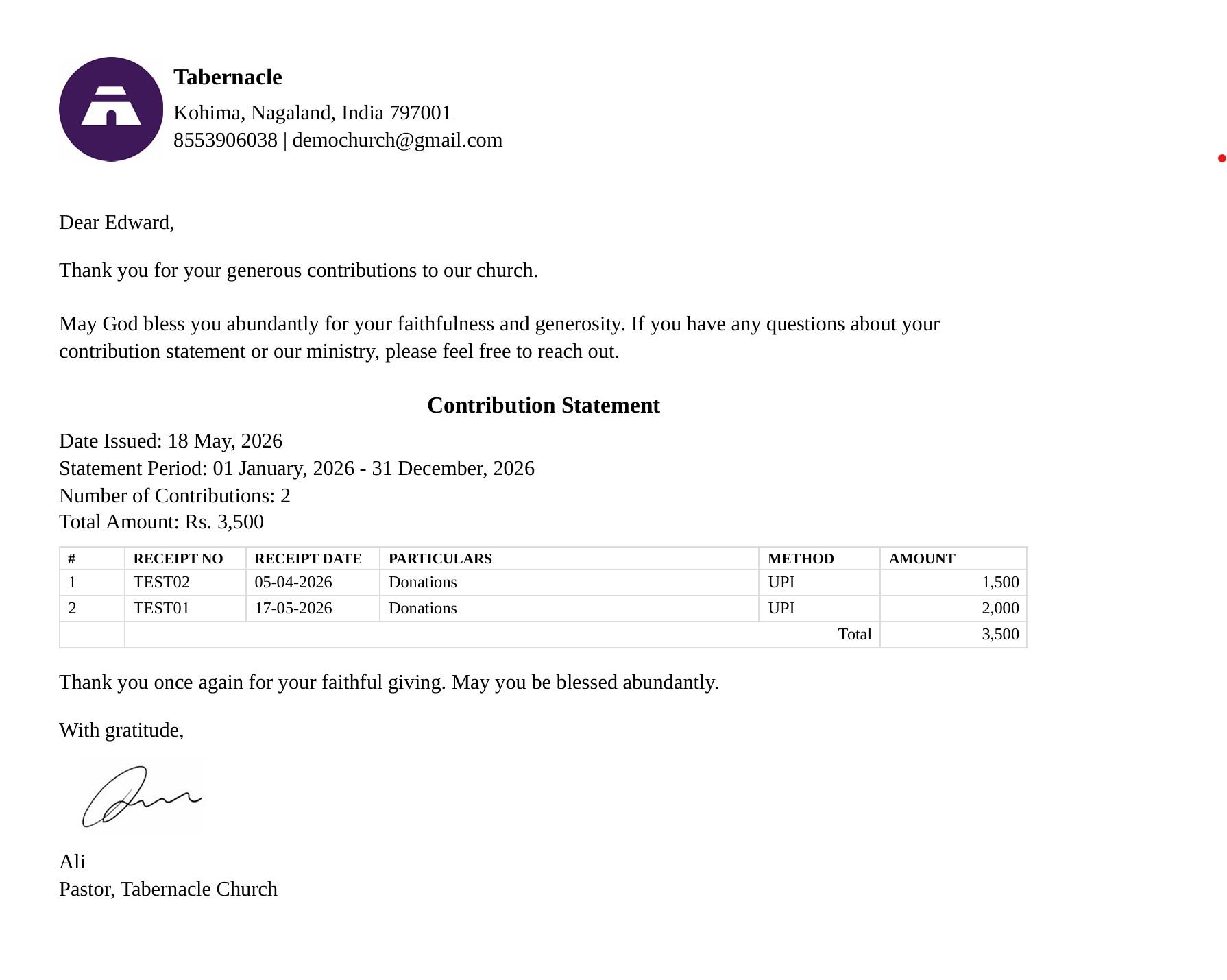
Every donation - cash, cheque, UPI, bank transfer - needs to be recorded against the right contributor, in the right fund, with a receipt. That sounds straightforward. In practice, it is where most manual systems quietly accumulate errors. A missed entry on Sunday gets noticed six months later when nothing reconciles. A gift recorded to the wrong fund causes problems when the building committee asks where their money went.
Donor Receipt Generation
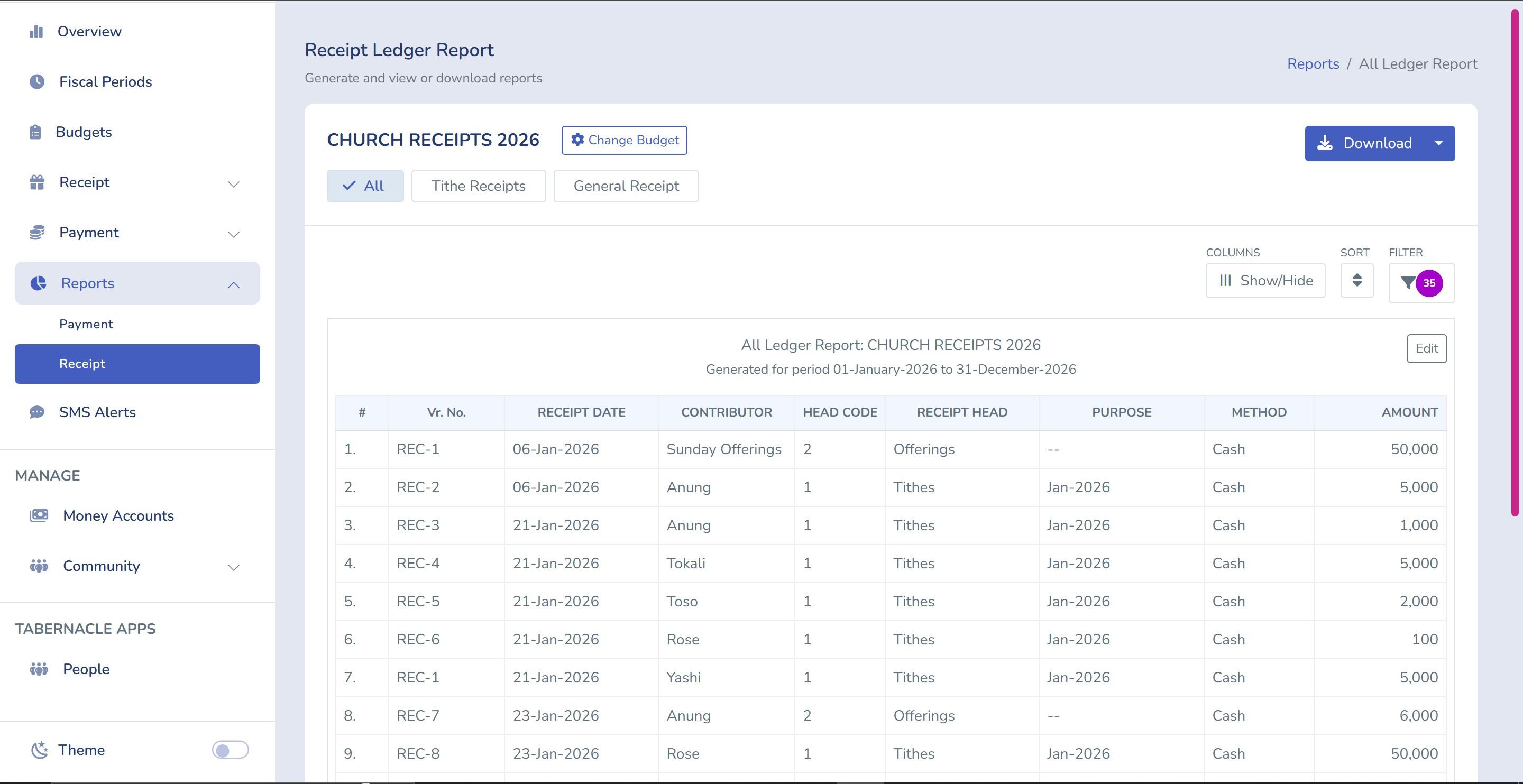
Every donor who gives to a church deserves a record of that gift - and in most places, they need one. Whether it is for personal records, tax purposes, or simply the reassurance that their contribution was received and noted, receipts matter. For a congregation of 200 members giving regularly, generating these by hand is hours of work that compounds every single week. A good church accounting system handles this automatically - the donation gets recorded, the receipt goes out, and nobody has to chase it down manually.
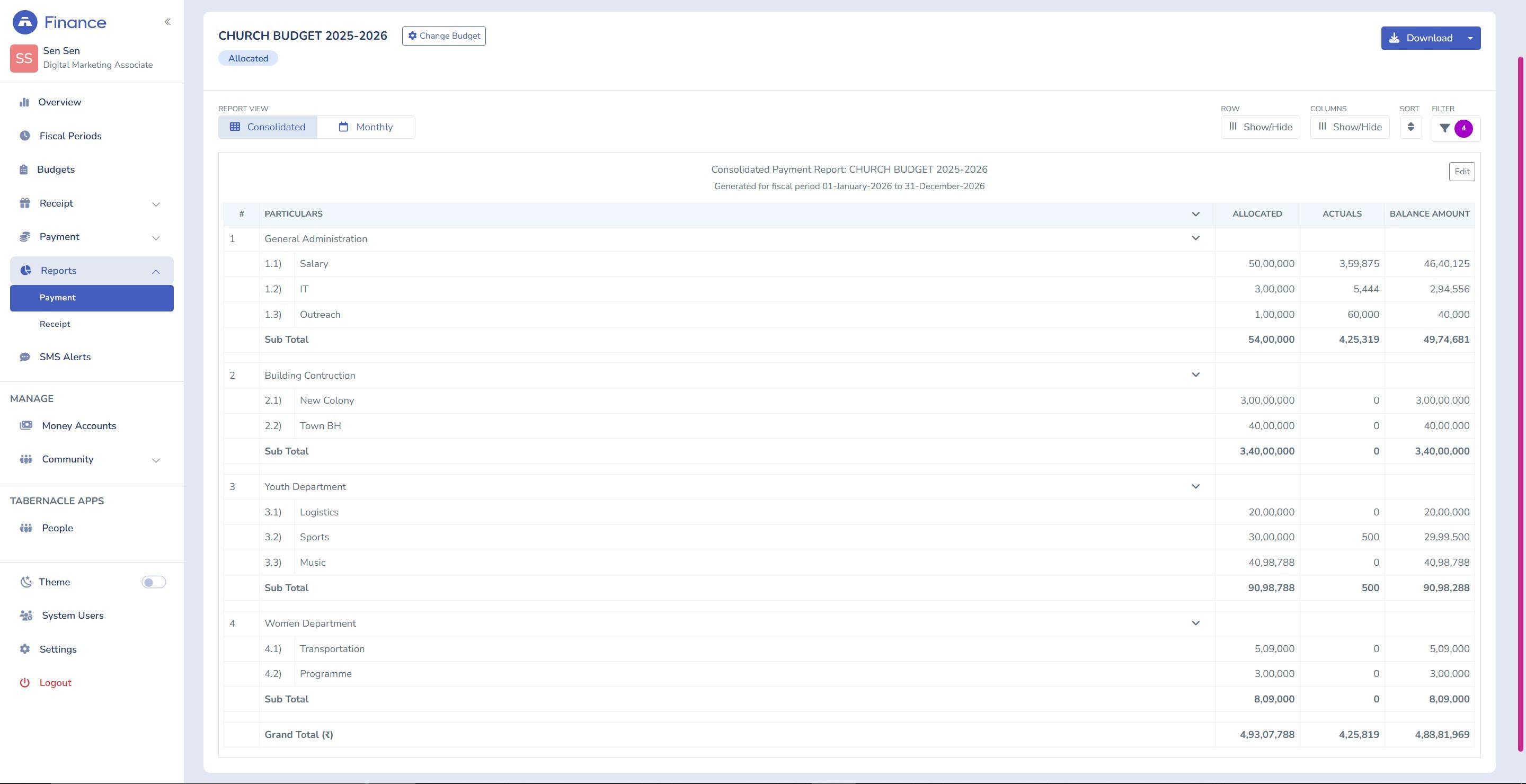
Budget Planning and Monitoring
A church budget is not one number. It covers staff salaries, Women's Ministry events, Youth Department programmes, building maintenance, missions giving - each with its own allocation. Church accounting software lets treasurers set those allocations at the start of the year, then track actual spending against estimates as the year moves. When a department is creeping toward its limit, you want to know before it goes over.
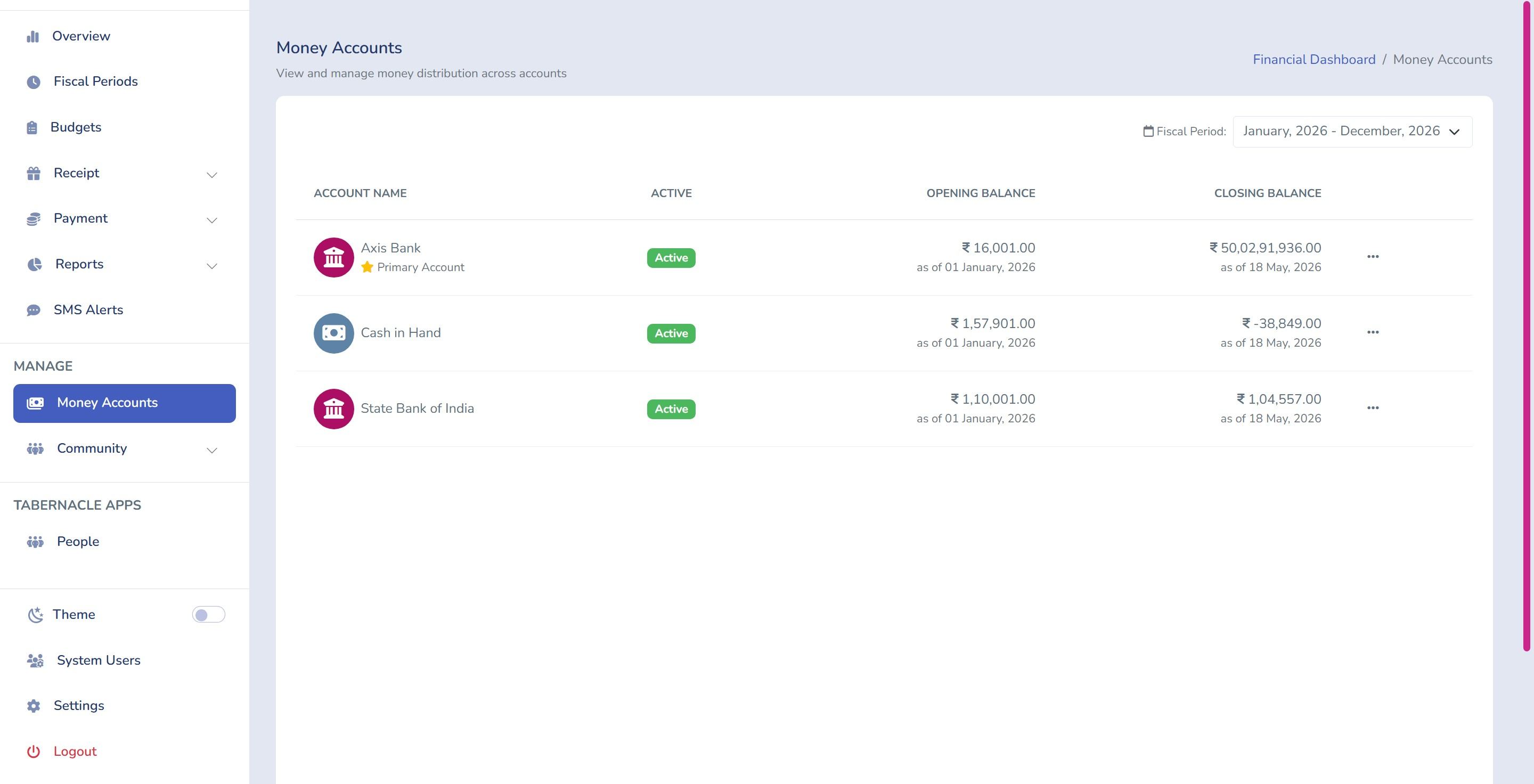
Money Account Management
Most churches hold money across more than one account - a primary bank account, sometimes a savings account, a cash float. Good church accounting software tracks all of them separately while giving you a consolidated view of the overall position. Mixing them up is where cash-handling errors hide.
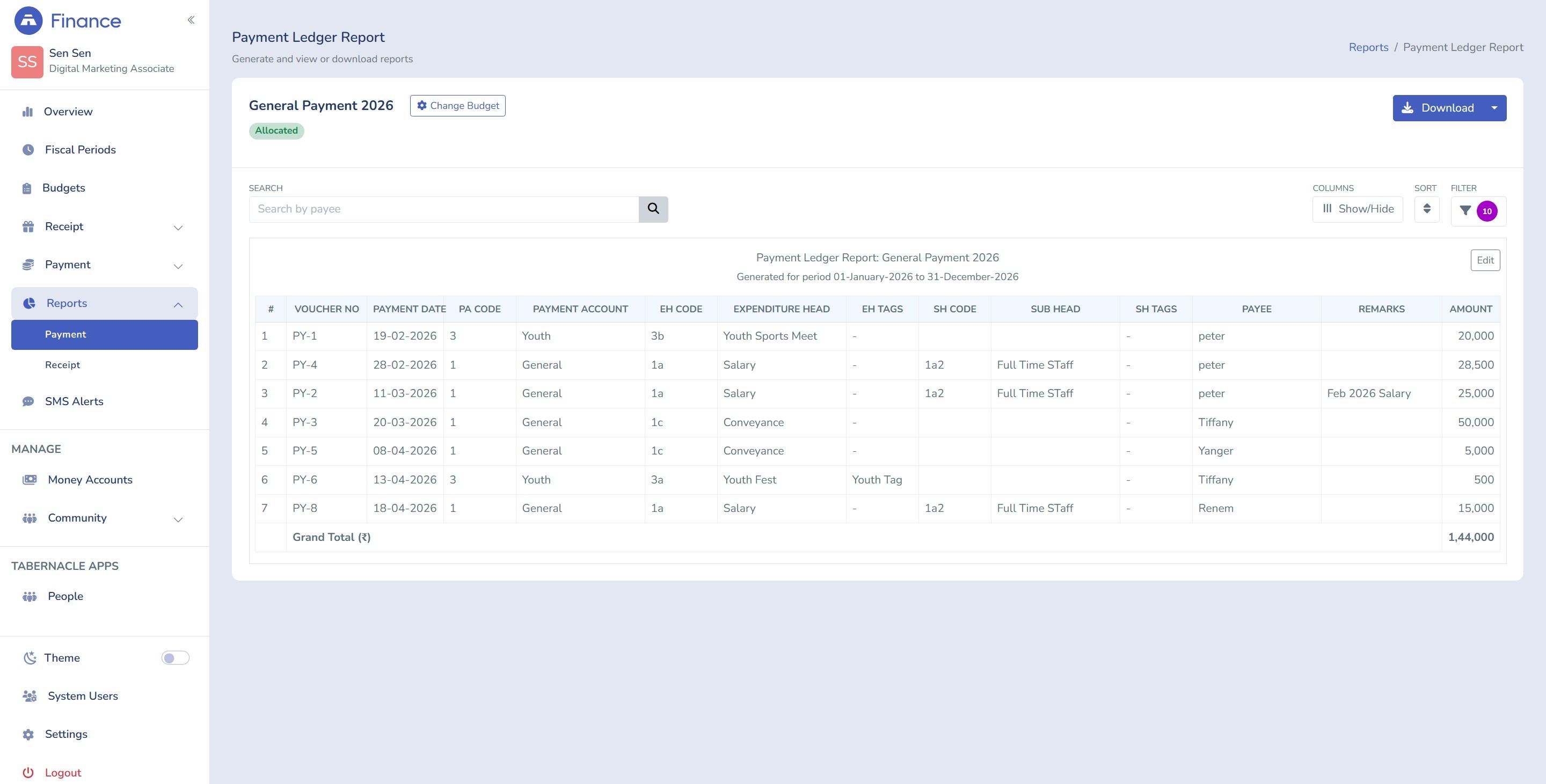
Payment and Expenditure Tracking
Salaries, stationery, maintenance, mission expenses - every outgoing payment needs to go against the right expenditure head in the right budget. A payee directory keeps this organised. It also means that if leadership asks how much has been paid to a particular vendor or staff member over the past year, you can answer in thirty seconds instead of thirty minutes.
Fund Accounting - The Concept Most Churches Get Wrong
Fund accounting is how a church keeps track of money by purpose, not just by total. Every donation belongs to a specific fund and stays there, so when a donor asks where their gift went, the answer is already in the system.
Most church treasurers understand income and expenses. What trips them up is fund accounting - and it's worth understanding properly because the consequences of getting it wrong are real.
In a regular business, money is money. It comes in, it goes out, you track the difference.
A church doesn't work that way. Different pools of money exist for different purposes, and they have to stay separate:
-
The building fund is for the building
-
Designated mission donations go to missions
-
The widow's fund and the general operating budget are not interchangeable
The real-world example
A church collects ₹50,000 for a new sound system over three Sundays. Two months later the general fund runs short before salaries go out. Someone moves ₹20,000 "temporarily." By December nobody remembers - and the sound system never gets built. That scenario plays out in churches that don't have fund accounting in place more often than most treasurers would admit.
The accounting terms worth knowing here are restricted and unrestricted funds. Restricted funds come with conditions attached - the donor gave for a specific purpose and that purpose is the only one the money can go toward. Unrestricted funds are general income that leadership can allocate as needed. The problems churches run into are almost always the same: restricted money gets used for something else because there was no system keeping the two separate.
Using one fund to cover a shortfall in another - even with every intention of paying it back - is a breach of donor trust.
Fund accounting is what keeps this clean. It lets you track each restricted fund separately, allocate income and expenses to the right pool, and generate reports that show the exact balance of every designated fund at any point in time.
Without it, you're usually managing five or six funds inside one spreadsheet. And anyone who has done that knows what year-end looks like - hours of digging to figure out where things drifted.
| Without Fund Accounting | With Fund Accounting |
| Mixed into general account | Separate, trackable at any time |
| Hard to verify at year-end | Every rupee traced to its purpose |
| Built manually, takes days | Generated in seconds per fund |
| Hard to prove money went where intended | Full audit trail per donation |
| Hours of forensic work | Clean, already organised |
Good church accounting software solves this at the budget level. Each budget works as its own fund - separate income heads, separate expense heads, separate reports. You can see the full picture from one dashboard, but drill down into any fund and every transaction is there, dated and traceable.
No more hunting through a spreadsheet at year-end wondering which entry belongs to which fund.
Church Chart of Accounts
A chart of accounts is the full list of financial categories a church uses to record every transaction. A business chart of accounts groups things around revenue and operating costs. A church one is built differently - income categories cover tithes, general offerings, designated gifts, and fundraising separately. Expense categories follow ministry departments: General Accounts, Women's Ministry, Youth, Building Fund, Missions.
Getting this right at the start matters more than it sounds. Every transaction recorded in the wrong category is a problem at year-end when the reports need to be clean. Most church-specific accounting software comes with a default church chart of accounts already set up. Generic software doesn't - you build one yourself, which usually means adapting something that was never designed for this.
Budget Planning for Churches
A church budget isn't just a financial document. It's a decision about what the church actually believes it should do within the next twelve months. How much goes to ministry. How much to staff. How much to the community.
Those decisions deserve to be tracked properly.
In practice, most churches set allocations at the start of the year and then largely forget about them - until something goes over. Then the treasurer is scrambling to explain a line item that nobody was watching.
Good church accounting software changes how this works:
-
Estimated income is set at the start of the year by source - tithes, offerings, fundraising, rental income
-
Expenditure is allocated by department
-
As the year moves forward, actuals get recorded against those estimates
-
Before any leadership meeting, the treasurer can pull a live view showing exactly where every department stands - without building a report from scratch
Budget alerts matter too. Knowing a department is approaching its limit before it crosses the line is what prevents the uncomfortable conversation where a ministry has overspent and finance only found out when it showed up in the bank statement.
Tabernacle's fiscal period management supports both the April-March Indian government fiscal year and the January–December calendar year, with separate budgets for each period.
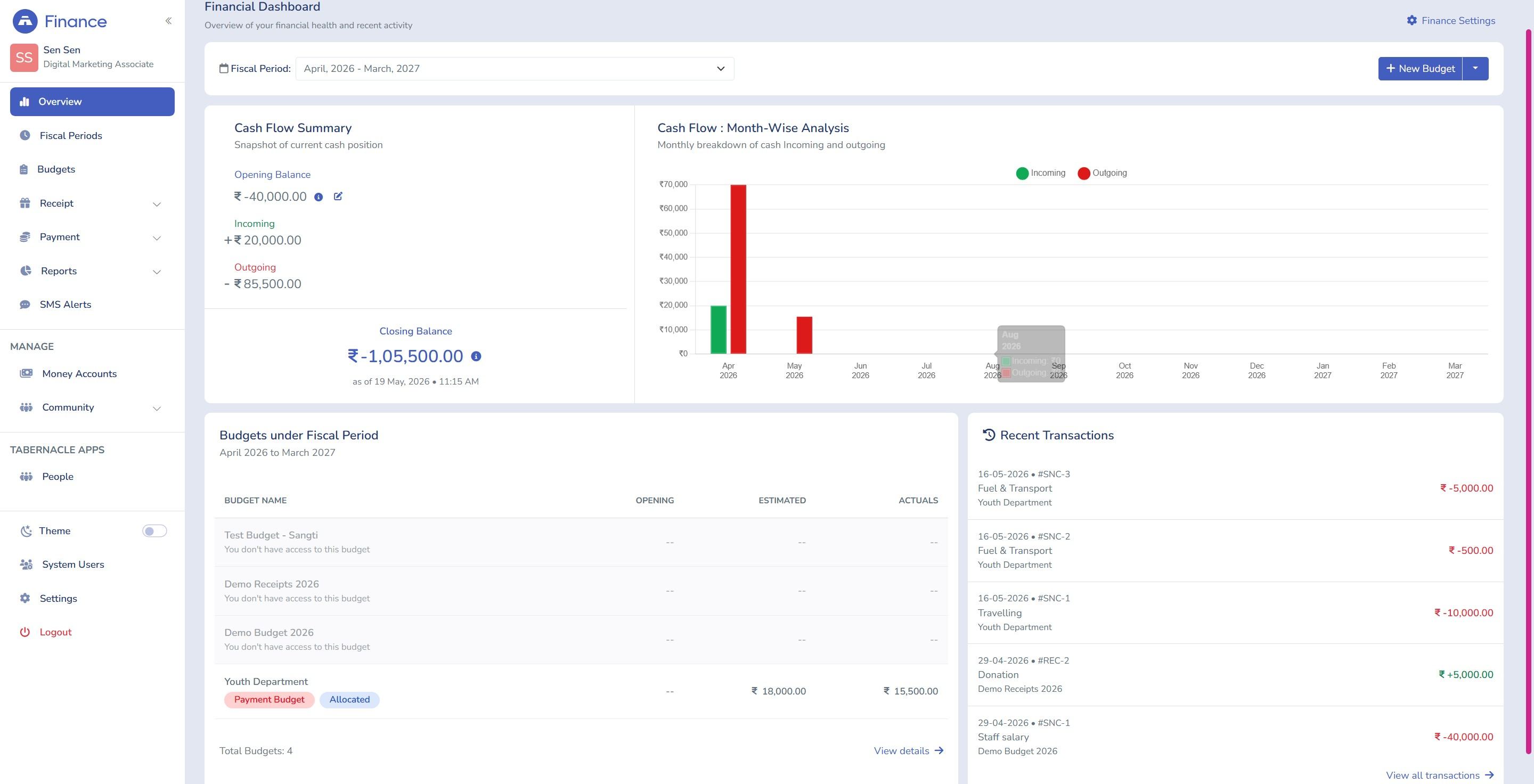
The Core Features Church Accounting Software Needs to Cover
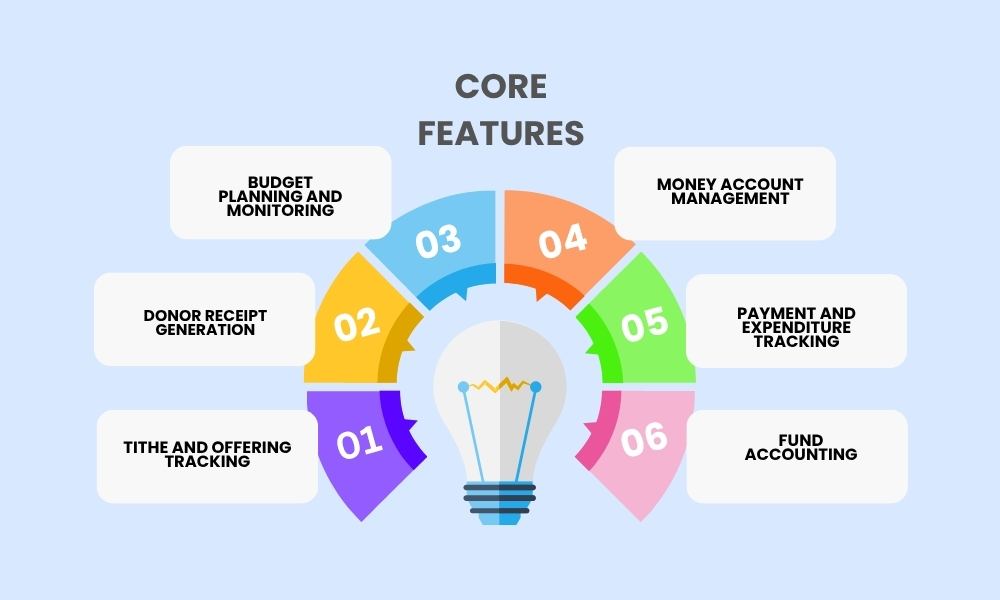
Not all church accounting software handles the financial side the same way. Some are strong on reporting but weak on fund tracking. Others handle donations well but fall apart at budget management. Here's what the financial side needs to do - each covered properly further down:
-
Tithe and offering tracking - every donation recorded against the right contributor, fund, and receipt category
-
Donor receipt generation - automatic, not manual, especially for churches with 80G registration
-
Budget planning and monitoring - allocations set at the start of the year, actuals tracked against them as the year moves
-
Money account management - multiple bank accounts and cash tracked separately, with one consolidated view across all of them
-
Payment and expenditure tracking - every outgoing payment logged against the right budget and expenditure head
-
Fund accounting - separate tracking for each designated fund so donor intent is always honoured
Church Accounting Software vs Spreadsheets
Spreadsheets work - for a while. A congregation of 40 or 50 members with one person handling finances can get by in Excel. The problems start when the church grows, the treasurer changes, or both happen at once.
|
Spreadsheets |
Church Accounting Software |
|
|
Audit Trail |
No record of who changed what or when |
Access Control |
|
Access Control |
Everyone sees everything or no one does |
Role-based access - youth pastor sees youth budget, not payroll |
|
Receipt Generation |
Manual, every single time |
Automatic on every donation entry |
|
Reporting |
Built from scratch each time |
Generated in seconds, any period |
|
Real-time Visibility |
Updated when someone has time |
Live - leadership always sees current numbers |
|
Bank Reconciliation |
Done manually, takes hours |
Tracked per account with running balances |
|
Fund Tracking |
One pool unless manually separated |
Separate funds with individual reports |
A recent data shows that Church Management Software, there is a massive shift happening globally as Churches are prioritizing mobile-first solutions and cloud-based infrastructure to handle daily operations.
How to Choose the Right Church Accounting Software
Start with questions, not the feature list.
|
Question |
What to look for |
Red flag |
|
Built for churches or adapted? |
Uses church terminology - tithes, receipt heads, fiscal periods, designated funds |
Generic fields renamed to sound church-like |
|
Proper fund accounting? |
Genuinely separate fund tracking with individual reports |
Single ledger with tagged categories |
|
Easy enough for a volunteer? |
Learnable without an accounting background |
Built for someone who already knows double-entry bookkeeping |
|
Handles local compliance? |
80G receipts, fiscal year flexibility, UPI recording |
Vague answers when you ask directly |
|
Onboarding included? |
Provider handles data migration from paper or Excel |
They send you an import template and point you to documentation |
|
Priced for your budget? |
Transparent pricing in rupees, sized for your congregation |
International software priced in USD that looks affordable until you convert |
If you're weighing up specific options, we've put together direct comparisons against some of the most commonly considered alternatives - Breeze, Planning Center, Servant Keeper, and Flockbase.
Running accounting and member records on separate systems means someone is manually reconciling them every month. Tabernacle keeps both in the same platform - a donation updates the contributor's profile and the right budget automatically, with nothing to sync afterwards.
Indian Church Compliance: What Your Software Needs to Handle
Most church accounting software guides are written for the US market. For churches registered in India, the compliance picture is different - and getting it wrong has real consequences.
80G and 12A registration
A church registered under Section 12A of the Income Tax Act is treated as a charitable institution - its income is exempt from tax, provided it is applied toward charitable purposes. Section 80G registration allows donors to claim a 50% deduction on their giving against taxable income. For a congregation where members are salaried professionals, this matters. Donors ask for 80G receipts. Churches that cannot generate them on time lose donor trust and, in some cases, future donations.
Your church accounting software needs to generate 80G-compliant receipts automatically - with the registration number, PAN, the donor's name and address, the donation amount, and the date. Manual receipt generation for 200 donors at financial year-end is a weekend's work that software should eliminate entirely.
FCRA accounts
Churches that receive funds from foreign donors or international missions organizations must hold those funds in a designated FCRA (Foreign Contribution Regulation Act) account - separate from domestic funds. Mixing FCRA and non-FCRA funds is a compliance violation with serious penalties. Your accounting software needs to track this separation clearly, not as a workaround but as a built-in account type.
The April–March fiscal year
India's government fiscal year runs April to March, not January to December. Budgets, audit periods, and tax filings follow this calendar. Software priced and built for the US market defaults to January–December fiscal years. That means your Indian church is either working against the software or manually adjusting every reporting period. Tabernacle's fiscal period management supports the April–March cycle as a default.
UPI and digital giving
Cash and cheque offerings still exist, but UPI transfers have become the default giving method for many church members, especially in urban congregations. Software that records UPI transactions correctly (with reference numbers, date, and fund attribution) closes the reconciliation gap that builds up when digital transfers get logged manually days after they arrive.
Common Mistakes Churches Make When Going Digital
|
Mistake |
What happens |
What to do instead |
|
Doing everything at once |
The team gets overwhelmed and nothing gets set up properly |
Start with the most painful problem usually donations or budget tracking get stable, then expand |
|
Starting fresh instead of migrating |
Every donor's giving history, prior-year budgets, and year-on-year trends get wiped |
A proper migration brings existing records into the new system don't leave that data behind |
|
Only one person knows the system |
When they leave, go on holiday, or get sick everything stops |
At minimum two people should know the system well enough to cover for each other |
|
Everyone has the same access |
Any staff member can see and edit everything a security and accountability problem |
Set role-based access from day one so people see only what they need to |
|
Skipping onboarding |
Software that looked simple in the demo turns confusing on a Monday morning with twenty things on the plate |
Onboarding time feels optional until it isn't treat it as part of the setup, not an extra |
How Church Accounting Software Supports Pastoral Care
The concern most churches have before switching isn't about features. It's - will this make things feel less personal?
Used well, it doesn't. Here's what actually changes:
-
The treasurer stops spending Saturdays reconciling records - and has time for people again
-
The pastor can see which members have gone quiet for a few weeks and reach out before it becomes a longer absence
-
The secretary stops rewriting the same member data across multiple registers
-
Nobody is scrambling before a home visit to find a member's contact or giving history
-
Administrative work stops competing with ministry work
Software doesn't replace anything relational. It just clears the desk so the people can focus on the people.
Here's what churches using Tabernacle have to say:
Anurag, church accountant At Life Transformation Church in West Bengal
Before switching to Tabernacle, Anurag was managing the church's finances across multiple spreadsheets - separate files for Sunday offerings, expense tracking, and donor receipts. Reconciling them at month-end took most of a Saturday. Generating 80G receipts at year-end was a two-day project.
After moving to Tabernacle, the same reconciliation takes under an hour. Receipts go out automatically. The finance committee can see a live budget summary before any meeting.
Where Church Accounting Software Is Heading
The shift happening in Indian churches right now isn't really about software features. It's about who the treasurer is.
Ten years ago, most church treasurers were older, long-tenured members who had maintained the ledger for decades. They were the system. When they left, they took the institutional memory with them. Many churches we talk to are still recovering from that kind of transition.
What's changing is that younger church leaders - pastors in their thirties, administrators who grew up with smartphones - are increasingly uncomfortable with a financial system that only one person understands. They want visibility. They want to be able to check the building fund balance from their phone on a Sunday afternoon without calling anyone.
That's driving three real shifts:
-
Mobile access is becoming non-negotiable.
A treasurer who can record Sunday's offering from the back row before leaving the building is more likely to keep records current than one who waits until Monday morning at a desk.
-
Digital giving has made same-day reconciliation possible.
When a UPI transfer arrives, it can be attributed to the right fund and generate a receipt in the same workflow - no separate step, no delay.
-
The finance committee's expectation of financial reports has gone up.
Five years ago, a printed spreadsheet was fine. Now, boards want to see a clean summary before a meeting, not after it. Software that can generate a budget-vs-actual report in thirty seconds changes how financial decisions get made.
Conclusion
Church finance isn't complicated, but it is specific, and generic tools tend to create new problems while solving old ones. The churches that handle it well aren't always the largest. They're the ones where the treasurer isn't working weekends, where leadership can pull a financial summary before any decision, and where every donor can trust that their gift went exactly where they intended. That's all good church accounting software is really supposed to not impress technology, just honest, transparent stewardship.
If you want to see how Tabernacle handles this specifically - fund management, budget tracking, donor receipts, and full financial reporting - explore how the Finance module works.
If you are still earlier in the process and want to understand church management software more broadly before focusing on the financial side, the complete guide to church management software is the right place to start.
Frequently Asked Questions
Is church accounting software different from nonprofit accounting software?
Yes. But the difference matters more in practice than it does on paper. Both handle restricted funds and donor reporting. Where they part ways is in the specifics. Church accounting software is built around tithes, weekly offering cycles, volunteer treasurers who've never studied accounting, and compliance requirements like 80G receipts in India or FCRA tracking for foreign missions funds. Nonprofit software is generally built for organizations with a paid finance function - someone who already knows the terminology. Churches rarely have that. The reporting formats are different too. What a church board needs to see at the end of a month looks nothing like what a nonprofit files with its regulator.
What is the difference between church accounting software and regular accounting software?
Church accounting software is built around tithes, designated donations, fund tracking, and church-specific reporting. Regular accounting software like QuickBooks or Tally is built for businesses - tracking revenue, expenses, and profit against clients and vendors. You can force business software to work for a church, but fund accounting requires manual workarounds that multiply over time and the reports will not match what church leadership actually needs to see.
How secure is church accounting software?
Reputable church accounting software stores data on encrypted cloud servers, meaning it doesn't disappear if a laptop gets lost or stolen. Access is controlled by login credentials, and role-based permissions mean not everyone can see everything, the youth pastor doesn't need to see payroll, and they shouldn't. That said, security is only as good as the passwords your team uses and whether access gets removed when someone leaves.
How does church accounting software help with financial transparency?
It makes it easier to show the congregation where their money went without spending a week preparing the answer. Reports can be pulled in minutes, giving summaries, budget vs actual spending by department, fund balances. When the finance committee or the congregation asks questions, the answers are in the system, not in someone's memory or buried in a spreadsheet only one person understands.
Do small churches need church accounting software?
A church of 50 or 60 members can get by in Excel. Past 100 members, the manual work grows faster than the congregation does. Most churches that make the switch find that the time saved in the first three months covers the cost of the software - and the accuracy improvement matters regardless of size.
Is church accounting software affordable for churches?
Church accounting software costs less than most people expect. Purpose-built options typically run $30 to $50 a month for congregations up to 500 members roughly what a church spends on printed bulletins and stationery in the same period.
Generic tools like QuickBooks or Tally can look cheaper on paper. They rarely stay that way once you account for the hours a treasurer spends each month building and maintaining workarounds that church-specific software simply does not need.
Does church accounting software work for churches registered under the Societies Registration Act?
Yes. A church registered as a society still needs to track restricted and unrestricted funds, file annual returns, and keep records clean enough to survive an audit. The fund accounting and reporting features in church-specific software cover all of that. What to check before committing: can it generate reports on the April–March financial year? Does it support 80G and 12A documentation? Those two things will matter every year at filing time, and vague answers during a demo usually mean no.
Can church accounting software handle multiple bank accounts?
Yes. It tracks each account separately - savings, current, FCRA, petty cash - while showing a consolidated financial position. Each account has its own transaction history and running balance.
What happens to existing paper records when switching to church accounting software?
A good provider migrates existing records as part of onboarding - paper registers, Excel spreadsheets, or data from another ChMS. Donor giving histories, prior-year budgets, and member records are preserved rather than written off.
How does a church handle FCRA funds in accounting software?
Carefully, because getting it wrong is a compliance violation, not just a bookkeeping error. Under Indian law, foreign contributions must be held and tracked completely separately from domestic funds. In your accounting software, the FCRA account should be its own fund with separate income and expense heads. Not a sub-account. Not a tag inside a general ledger. Its own fund. Every foreign receipt gets logged there specifically, and when the annual FCRA return comes around, you should be able to pull the reconciliation directly from the software without rebuilding it from scratch.
How is church fund accounting different from regular accounting?
Fund accounting tracks money by purpose, not just by total. A building fund, a missions fund, and a general operating fund stay separate - money given for one cannot be spent on another without a serious breach of donor trust. Regular accounting software treats all money as one pool, which does not match how churches are responsible for managing designated giving.
Can a church use QuickBooks for accounting?
Technically yes. But it gets messy. QuickBooks has no concept of a tithe, no fund accounting, and the reports it generates don't answer what a church board is actually asking. Most churches that go this route spend more time managing workarounds than managing their finances.
Is there free church accounting software?
Some platforms have free tiers. They usually cap the features that matter most - fund tracking, reporting, or donor receipts tend to sit behind a paywall. A free tool that covers 60% of what a church needs often creates more work than it saves.
How does a church treasurer actually use this day to day?
Donations come in, get recorded against the right contributor and fund, receipts go out automatically. Expenses get logged against the right budget head. Before any board meeting, a financial summary takes thirty seconds to pull. The treasurer stops rebuilding the same spreadsheet every month.
Can one person handle a church's finances with accounting software?
Most small church finance teams are one person - a volunteer, usually, fitting this around a day job. That's exactly who this kind of software is built for. Simple enough to learn without an accounting background, with reports that leadership can read without needing them explained.

Duties and Responsibilities of a Church Treasurer
A church treasurer records gifts, banks them, pays approved bills and reports to the church. Here are the seven duties …

Church Treasurer Handover: Why Every New Treasurer Starts From Scratch
Most church treasurer handovers fail because records live in one person's head. Here's what actually needs to change ha…

How to Keep Church Giving Records Accurate
Most giving record errors don't happen because of bad software. They happen in the counting room. Here's where accuracy…
