
Church financial management: where to start
New to church finances? Here is where to start: roles, budgeting, offering counts, controls, records, and reporting, in six clear steps.
Church financial management is simply how churches plan, receive, record, spend, and report on their financial resources so their mission is funded, and give their congregation peace of mind knowing their gifts are being used as intended. It includes everyday tasks such as counting the offering, as well as larger responsibilities such as budgeting, managing the budget, and preparing the church's annual report.
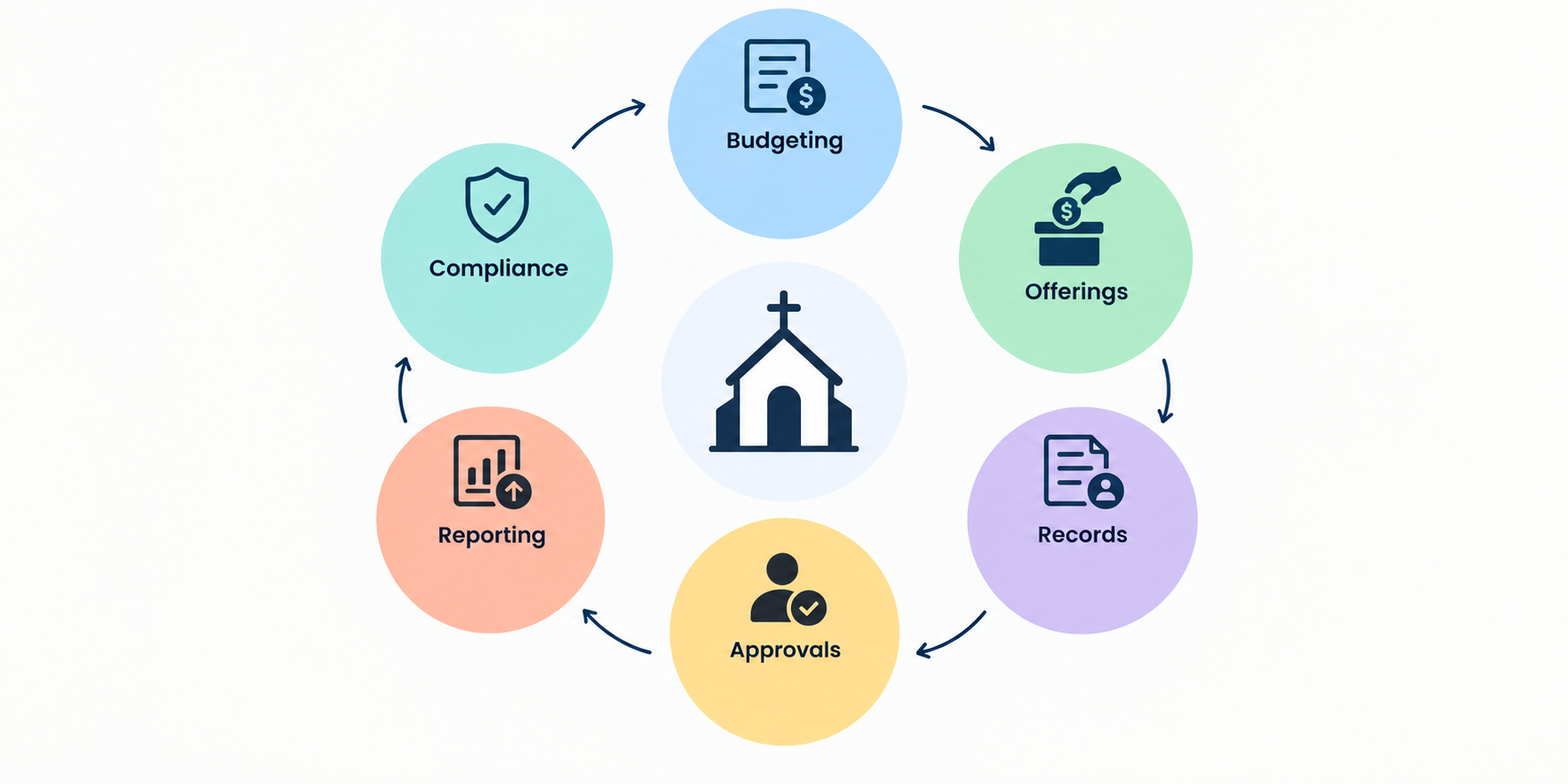
It usually covers the following:
Budgeting: Deciding in advance how money will be spent.
Offerings: Collecting and counting of gifts safely.
Records: Recording every contribution and expenses
Approvals: Knowing who can approve a purchase
Reporting: Showing leaders and members where money was spent.
Compliance: following the rules and regulations of your country, state or denomination.
Church financial management works best with a consistent routine, with clear responsibilities and regular financial checks every week or so.
Launch your church into the future
Everything your ministry needs — giving, events, members, and more. Try it free, no credit card required.
Start Free Trial No credit card • Cancel anytimeDoes church financial management matter?
You are bringing in a contribution or a gift and you expect your contribution or gift to be used responsibly. This is what happens with church money. You give or contribute for a particular reason and in return you expect that reason to be fulfilled. But how do you know that? Paul addressed this issue in his second letter to the Corinthians urging them to do what is right in the eyes of God and man ( 2 Corinthians 8:21). On this verse The Evangelical Council for Financial Accountability built its Seven Standards of Responsible Stewardship.
A good financial management protects three groups:
-
Members, who can see where their giving went
-
The presence of clearly defined rules will protect both the treasurer from false accusations of wrongdoing and the church from making errors.
-
Pastors, who shouldn’t have to guess whether the church can afford something
Imagine a church where only one person in the church knows about the treasury, including the bank balance, passwords, and what fund is paying off what. Then this person becomes sick or moves from the area or retires. The leaders of the church cannot know what has already been paid by church goers. Members ask for reports, but these have not been made.
Another problem is training. Pastors are taught to manage, instruct, and help people but not to maintain accounting records. This is not a problem; it shows that the church should have a mechanism that does not rely on the particular person's intuition.
So where should a church start with its finances?
Start with employing people, followed by the procedures and equipment. The six steps below follow that order.
Step 1: Who is responsible for managing the church money?
To start with, designating positions is necessary. Even for a small church they need this four:
-
The treasurer - this person is in charge of book-keeping and bill payment.
-
The financial team - two or three individuals engaged in the work of reports examination and budget drafting.
-
The counters - several individuals whose task is to count money.
-
The pastor or board - this person or people give the final verdict for important financial decisions.
There is one important rule to remember: The person counting the money should not only be the person who also does the records and reports. Splitting those jobs to different people can be one of the cheapest protections a church can use.
In case you’re still figuring out what you’d like a treasurer to do, take a look at our guide that explains the duties and responsibilities of a treasurer. When a new treasurer takes over the office of the church treasurer, there are steps to be taken so that records do not get lost as a result.
Step 2: What is the procedure to create a budget for a church?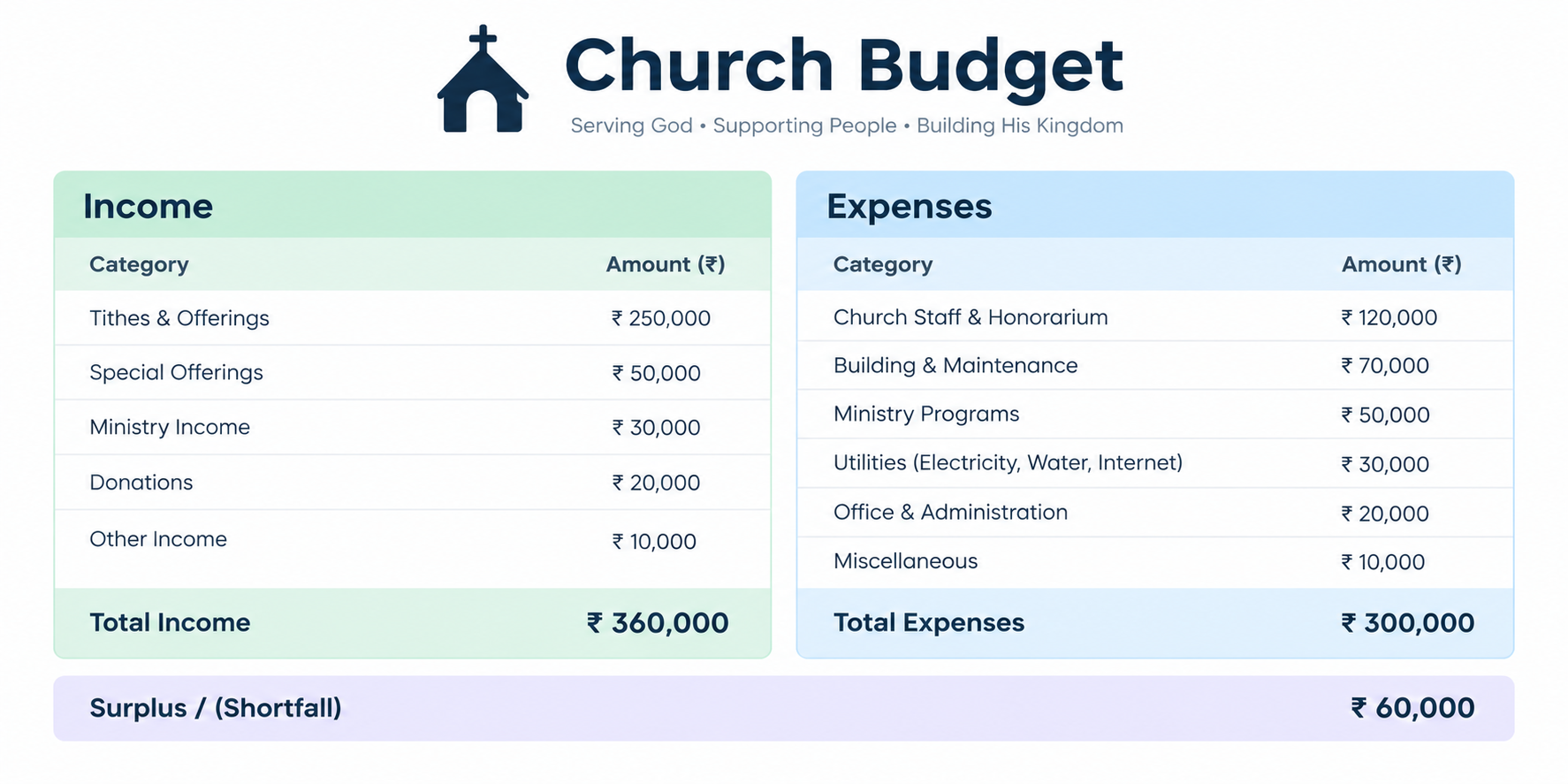
A budget for a church is a written outline of projected income and expenses for the year, which is approved by church leaders ahead of the start of the year. For your first church budget, you should keep it as simple as possible:
-
First comes listing income sources from the previous year, such as donations, gifts, contributions in kind.
-
Next, comes identifying fixed expenses that include salaries, rent or mortgage payments, utilities, and insurance.
-
The next steps include writing down all ministry expenses like youth activities expenses, mission costs, outreach costs, music spending, and other expenses.
-
Reserve some funds even if they look small.
-
Finally, you should compare income figures against this figure and make adjustments until they are in balance.
Then focus on the expenses that appear once per year. These cause more financial havoc than any monthly expense:
-
Renewal of Insurances
-
Maintenance and construction
-
Events that are regularly happening
-
Providing care and support to people who need it
-
Pastoral care and trips
Assign an appropriate monthly cost of those expenses, so that you don’t face a sudden cash outflow with one bill. If you don’t have any figures yet, take real figures for three months and do a conversion.
Your first budget will likely not be perfect, which is okay. Keep adjusting it every month. A rough budget that the church follows usually beats a perfect one sitting in a drawer.
Step 3: What is the procedure for assigning donations and contributions?
Two persons who do not know each other must work together in order to operate all donations. They must also record their results in a written document and deposit money fast. This is a practice that helps keep many money troubles off before they start.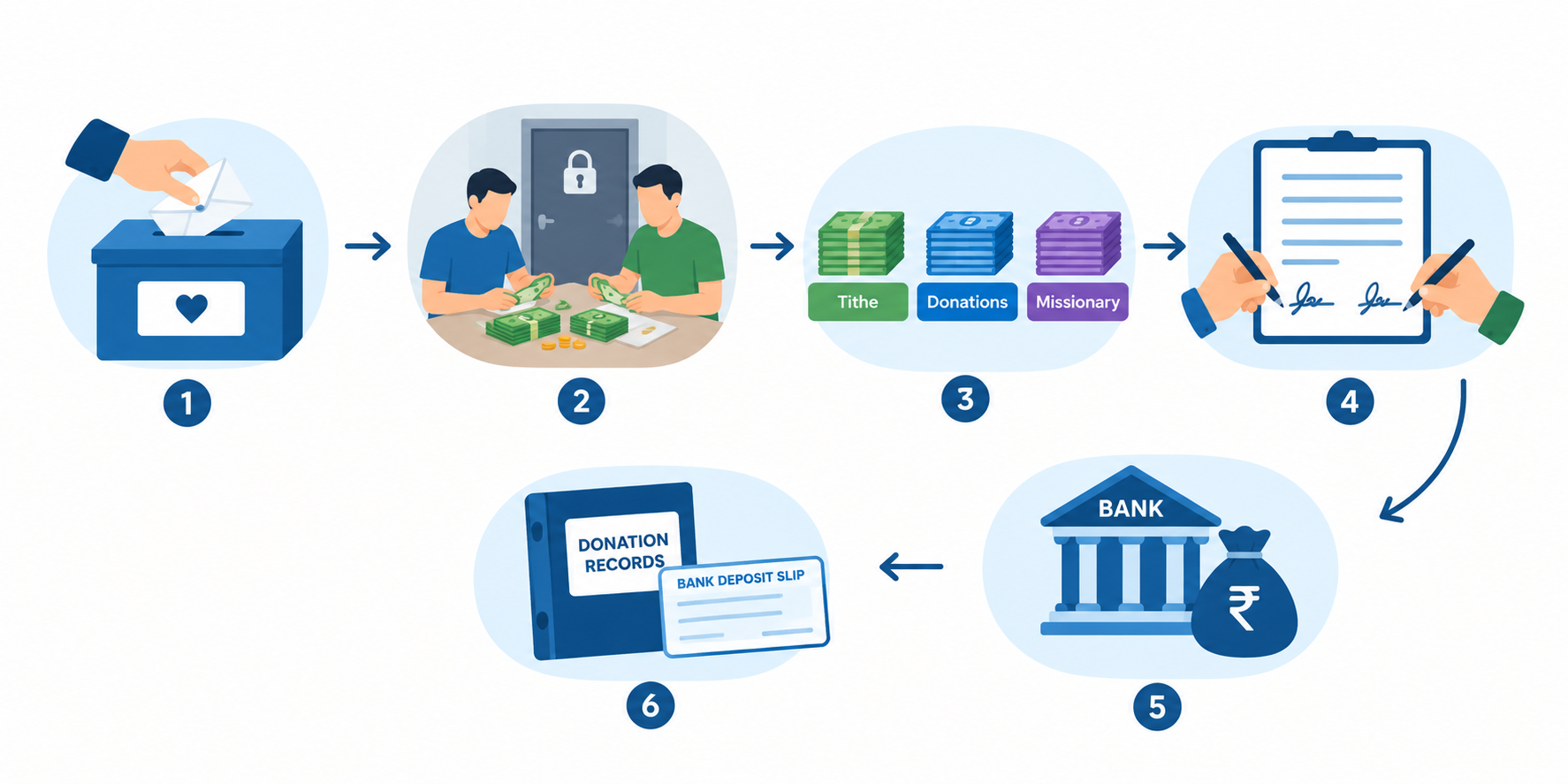
The simple process is the following:
-
Gifts should be collected in either sealed bags or boxes
-
Two people from two different families should count the money in the locked room
-
Numbers must be sorted according to their kind, such as tithe, donations, and missionary donations
-
Two people must sign a document confirming their results
-
Money must be deposited straight away or kept safe till then
-
The document must also contain a bank deposit slip
Many churches nowadays receive funds in multiple forms: cash on Sunday, bank transfers during the week, and online donations. All of these forms should tally to one record. Our previous post about keeping church giving records accurate goes into details about how these records could get messed up while church donation management software will explain how to consolidate multiple forms of donations.
Make sure to keep records of donations for each person from the beginning. Regular donors will generally want a statement of their donations, especially in regions where this matters for tax. Regulations differ from country to country so it is best to contact your local tax office and find out what is relevant to individual countries.
Stage 4: What financial regulations does a church require?
Regulations are the rules that make the mistakes visible and the misuse of them difficult to achieve. There are no motives for anyone to be guilty; rather, it signifies that the church values its donations.
A starter set:
-
A compulsory approval for any expenses above the limit your leaders have determined.
-
Having a receipt or an invoice for every expense, even minor costs.
-
Performing monthly bank statement checks carried out by a person not responsible for cash.
-
An established reimbursement policy for individuals who spend their own funds.
-
Ensuring that no money is spent prior to being registered, counted.
-
Removing bank access when a person authorized as a spender or treasurer quits.
-
Taking an annual auditing of the finances by professionals outside the financial department.
Every principle responds to a simple inquiry. Who gave the approval? Is there any proof? Finally, do you think anybody would notice any discrepancy regarding the numbers? When all these three questions have straightforward answers, everything is perfectly alright with your church finances.
Start with just a few principles instead of all of them. Following a principle every week is definitely better than going through pages of a complicated document that nobody remembers.
Step 5: How do you manage income and expenses?
Make sure you document each transaction with precise details: date, amount, payer/receiver, category, and authorization.
For example, one line in the record could explain: 12 March, 5,000, tithe, general fund, counted by two people. Another could be: 14 March, 1,800, electricity bill, utilities, authorized by the treasurer and the pastor, with attached receipt. Simple, but very informative.
Finally comes a very important thing that many churches fail to do: fund tracking. When someone gives money for the building fund or missions, that money has a purpose! Therefore, funds must be kept separately in your records, even if it’s sitting in one bank account.
You have three realistic tools to keep those records in:
|
What a church requires: |
Tabernacle (All-in-one church software) |
General accounting software (e.g. QuickBooks, Xero, Zoho Books) |
Using spreadsheets |
|
Monitoring donations (tithing, building projects, missions) |
Excellent keeping records of funds |
Requires some configuration |
Manually created columns and sheets |
|
Status report of each donor |
Combines recordkeeping for every member |
Generally does not have built-in tools |
Input by hand and can easily be skewed |
|
Record of gifts from different sources in one place |
Collects all financial information in one file |
Requires additional equipment/installation |
Created through manual work |
|
Reports on donations |
Summary of giving record of every member |
Usually difficult without any donor data |
Each update requires manual creation |
|
Responsibilities of the treasurer |
Information is preserved |
Information will be preserved, but none of system knowledge |
Tied to a single user’s spreadsheet. |
|
Why this is beneficial |
Churches that have finance and donation needs and requires and all in one management software for their church |
Having accounting specialist |
Church which were recently built |
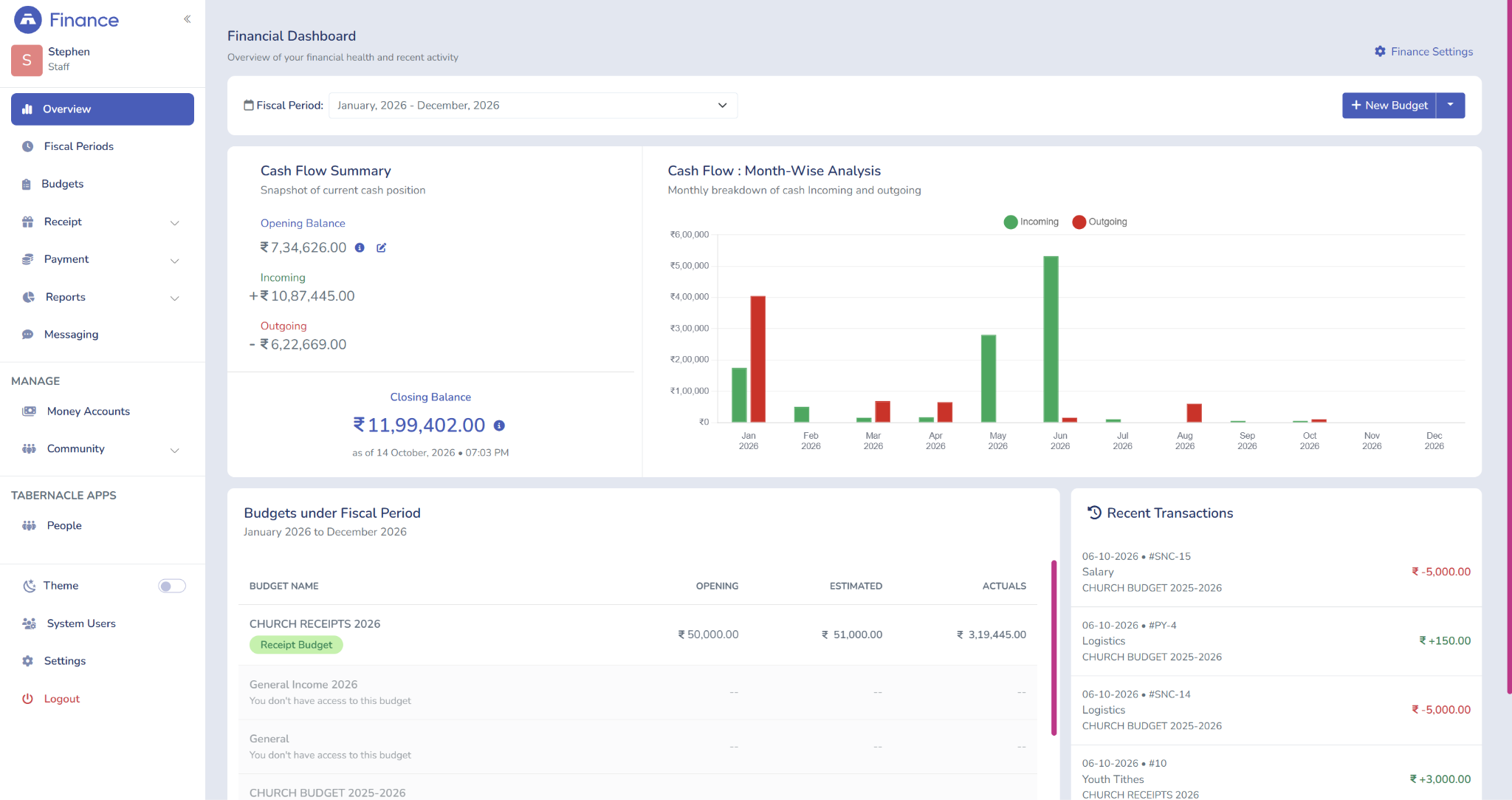
The spreadsheet does its job until it doesn’t. If you record a few donations and just one person is in charge of the file, this is quite enough. General accounting software is good only if there is an accountant who will be able to set them up. However, if donations are made in various ways, congregants want statements, or the accountant changes, church accounting software is of great advantage since it has already been made to take donations into account. One example of such software is called Tabernacle. Our guide on church accounting software tells you the things you should pay attention to when choosing this software.
Step 6: What's the best way to report on the church’s finances to the congregation?
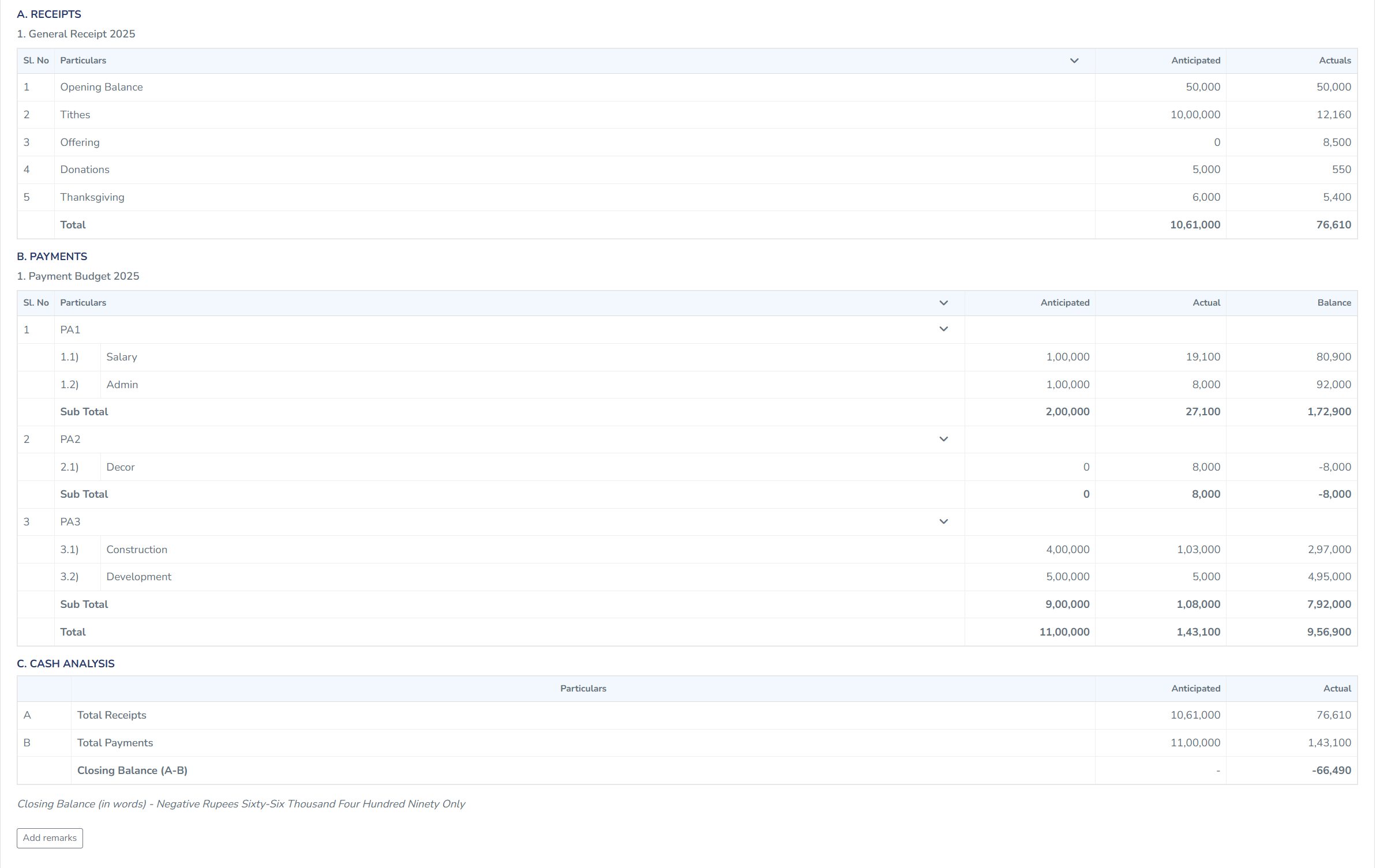
Regular reports presented in an easy-to-understand way
Each month give your church leaders a brief report on:
-
Where money has come from
-
What money was spent on
-
What the balance is
-
How the financial situation compares to the budget.
It is best to send a detailed report to the church at least once every year:
-
What is the total income
-
What are the main sources of income and spending
-
What was spent on various categories
-
What the balance is for each fund and how it compares with the budget.
A simple report might look like this: “The income exceeded the expenditure this quarter, the building fund is OK, and salary costs dominate the expenditure structure.” A one-page report is all one needs.
Keep the reports to one page where possible and do not conceal any shortfall. Honest reports allow other members to help whereas a vague report raises questions among them. This is called a "credibility cycle" by church financial officers in the global church of Seventh-Day Adventists: accountable leaders and open auditing build trust among the members, Adventist News reports.
[IMAGE 4: Sample one-page monthly finance report. Alt text: “Example monthly church finance report with income, expenses, and balance”]
What could be accomplished before this coming Sunday?
You do not have to do everything at once. Select these five:
-
Choose your treasurer, counters, and finance committee
-
Decide the limit of payments that needs to be approved
-
Print out an offering counting sheet
-
Create a basic income and expenditures record
-
Put a date to the first monthly summary
Frequently Asked Questions
1. What is the effective way of managing church finances?
A church must first define specific duties, develop a budget, keep records of all transactions and check financial accounts from time to time.
2. Who has the responsibility of church finance management?
A treasurer and the finance team can handle the financial accounts and monitor them, while the pastor or church board should manage major decisions regarding finances.
3. How can a church prevent misuse of funds?
It must keep proper records, stop items being purchased without approval, have different people manage different aspects of finances, and check the bank statements regularly.
4. When should a church turn to financial management software?
It is advisable for a church to start using it when it becomes impossible to keep track of things manually or when keeping records becomes too complicated.
Ready to transform your ministry?
Join hundreds of churches using Tabernacle — free for 14 days.

New Security Feature in Tabernacle - Remote Logout
A lost or damage laptop should not mean open access. See how Tabernacle admins can sign users out of devices remotely.
Church Administration: Building an Organised Ministry
Church administration covers records, money, people and meetings. See who in your church handles each part.

Duties and Responsibilities of a Church Treasurer
A church treasurer records gifts, banks them, pays approved bills and reports to the church. Here are the seven duties …
