
Duties and Responsibilities of a Church Treasurer
A church treasurer records gifts, banks them, pays approved bills and reports to the church. Here are the seven duties and a simple weekly to yearly schedule.

What does a church treasurer do?
The church treasurer is charged with ensuring that the church’s funds are being properly managed. They have to keep track of donations that come in and ensure that bills are prepared and settled with the necessary approvals. Moreover, the treasurer must make sure that the church funds are used according to their intended aim and inform the church board and congregation members about the financial status.
The responsibilities and duties assigned to a church treasurer can be summed up into key tasks: to record all contributions received, ensure their safe handling, process them as authorized and report on them in an honest manner. All other responsibilities described in a job description arise from these four main jobs.
What matters the most here is about a treasurer working alone - it’s impossible to prove one is innocent.
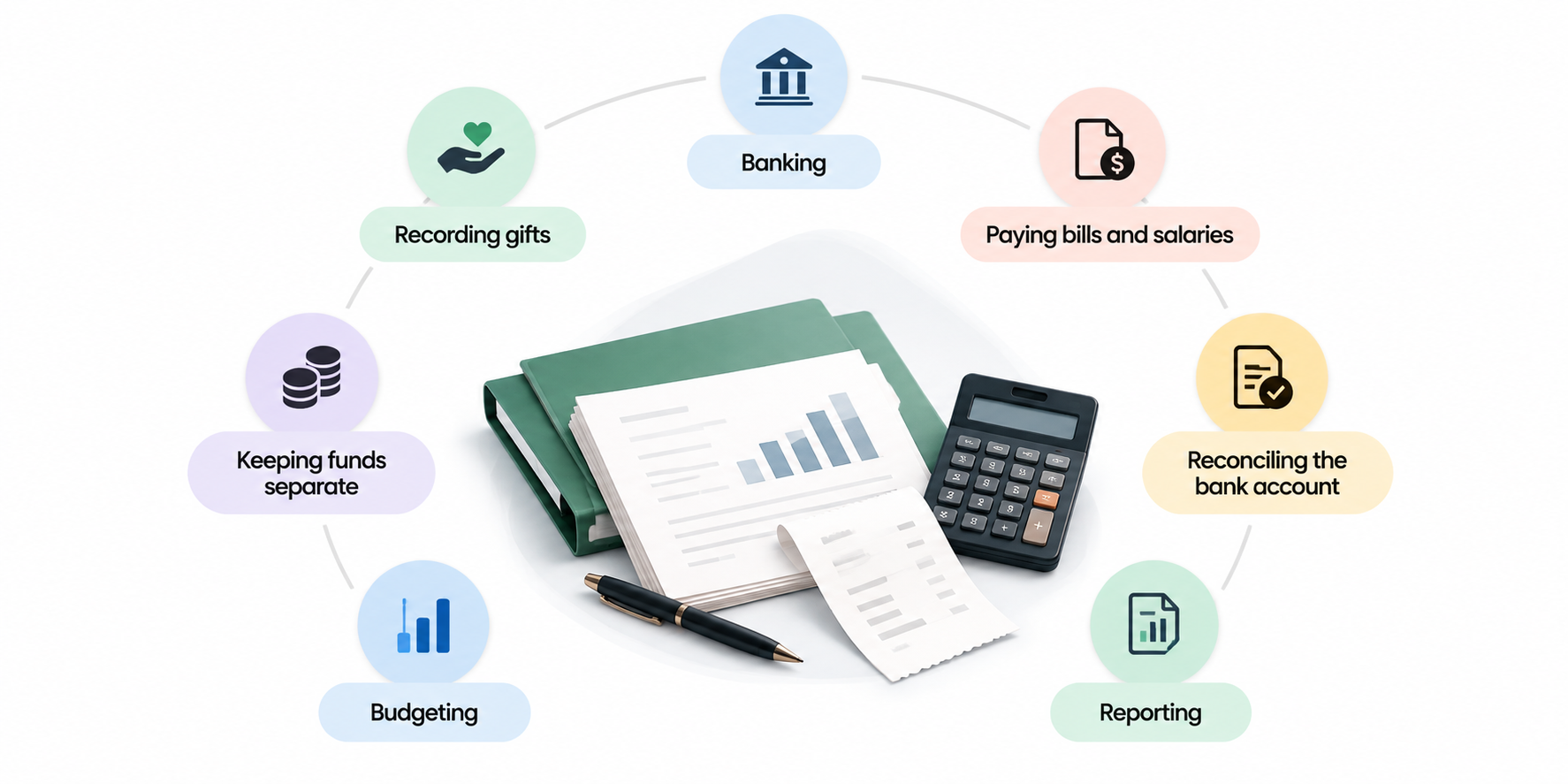
In practice, the job covers seven areas:
-
Recording of gift
-
Banking
-
Paying off bills and salaries
-
Keeping funds separate
-
Reconciling the bank account
-
Budgeting
-
Reporting
Main duties and responsibilities of a church treasurer
1. Keep a record of every donation
Every tithe, donation and any gift should be recorded in writing at the time it is received. Record the date, amount, donor and purpose.
-
Record cash, cheques, UPI and any bank transfer in the same way
-
Providing a receipt when necessary
-
Record the purpose of designated donations, such as building funds or missions.
2. Deposit funds promptly and securely
Cash that remains unexplained is easy to lose
-
Ensure prompt deposit of donations instead of taking them home.
-
Make sure the church funds are kept in the church account and not in a personal account
-
Making sure cash is kept in a safe place until deposited.
3. Payment of bills and salaries requires approval
The treasurer will pay the bills for which the church has given to go - ahead and not based on one person’s instruction.
-
Pay according to the approved budget
-
Obtain broad permission for any additional payments required.
-
Retain the invoice or payment advice to back up each payment made.
-
Avoid signing blank cheques or providing cheques to cash.
-
Pay the pastor and staff on the agreed date.
4. Keep funds separate
Funds donated for use in a specific project must be used for that very purpose - a donation made as a building fund should not go towards the payment of the electricity bill.
-
Allocating different ledger account for each fund
-
Each fund’s purpose should be recorded at the time of receipt of the donation.
-
Informing the board about the balance of each fund.
5. Reconcile the bank account on a monthly basis
Reconciliation is the process of comparing what your records show with what your bank statement shows. If there are any differences, you need to determine what caused those differences.
-
Go through all the entries one by one with the blank statement.
-
Clarify the discrepancies in the month.
-
Get someone else to look through them and sign off on everything.
6. Make a budget and keep track of it
The treasurer works with the finance committee to develop the budget but also keeps track of actual expenses based on the budget.
-
Begin with actual figures from the previous year.
-
Carry out a monthly comparison between the figures in the budget and real expenses.
-
Inform the pastor and the church council as soon as possible when the expenditure for any category exceeds what was planned.
7. Reporting to the broad and community
Reports create trustworthy numbers. Keep them simple and concise.
-
Make sure to send a monthly report to the board with cash, the state of finances, expenses, and income.
-
Share a summary report with the community at least once every year.
-
Mention major changes with just one or two sentences explaining the change involved
Launch your church into the future
Everything your ministry needs — giving, events, members, and more. Try it free, no credit card required.
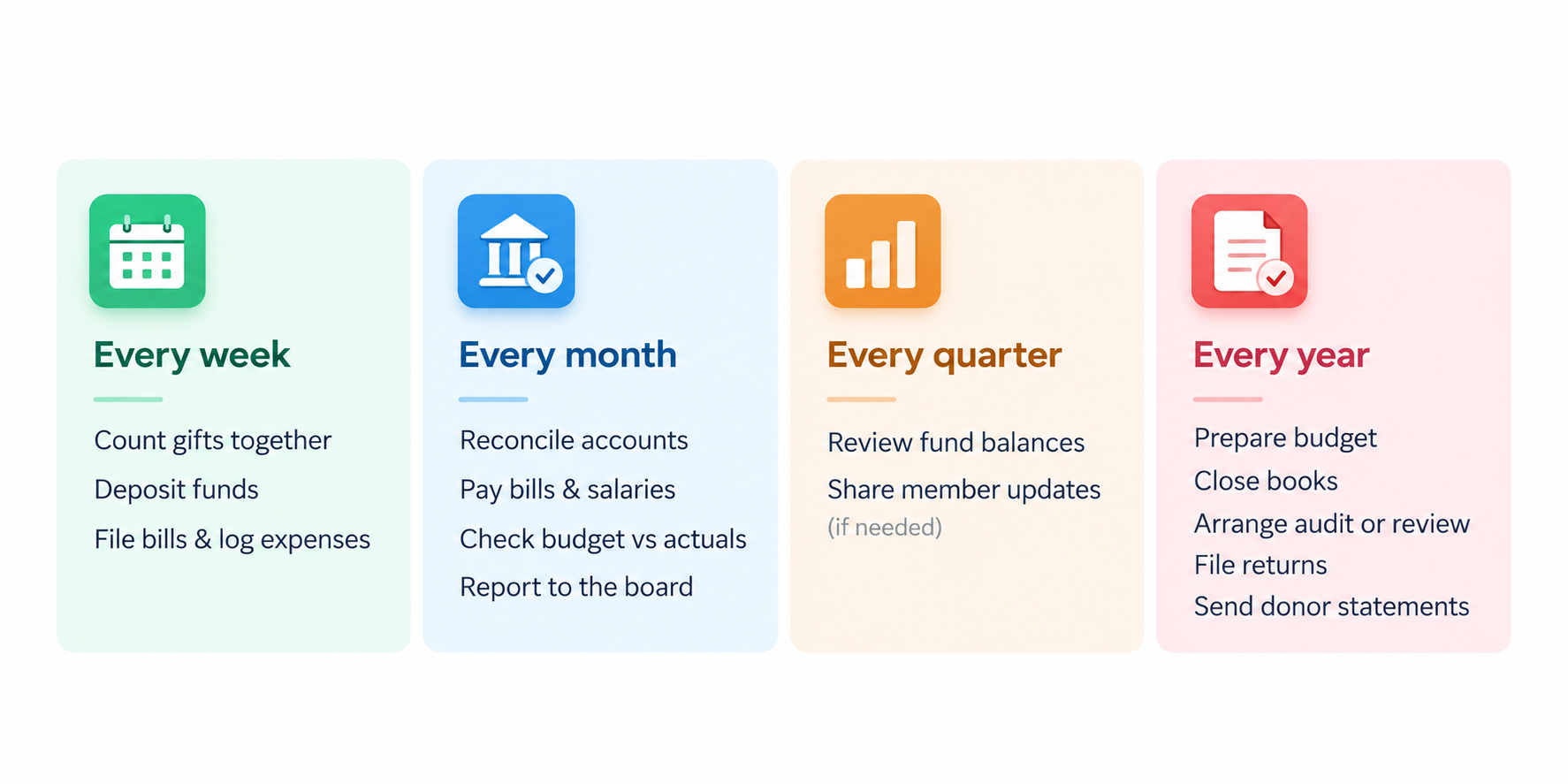
Start Free Trial No credit card • Cancel anytimeSchedule of the Church Treasury tasks
|
Weekly |
Each week, the Church Treasurer will keep track of the donations, post them in the books and the accounts of the financial transactions for the week, bank the money, and file receipts of expenses accrued. |
|
Monthly |
Each month, the Church Treasurer will reconcile the bank account’s transactions, pay off regular bills such as salaries, compare the budget versus the actual figures for the month, and submit an income and expenditure report to the board. |
|
Quarterly |
Every quarter, the Treasurer will review the funds balances with the finance committee and should provide the church members with the summary if the church has a system in place to disseminate it. |
|
Annually |
Once a year, the Church Treasurer will prepare an annual budget, finalize the financial reports for the year, manage the audit or the independent review of the church’s finances, file the donor returns and give away reports to the donors. |
How can a small church protect its money with only two or three volunteers?
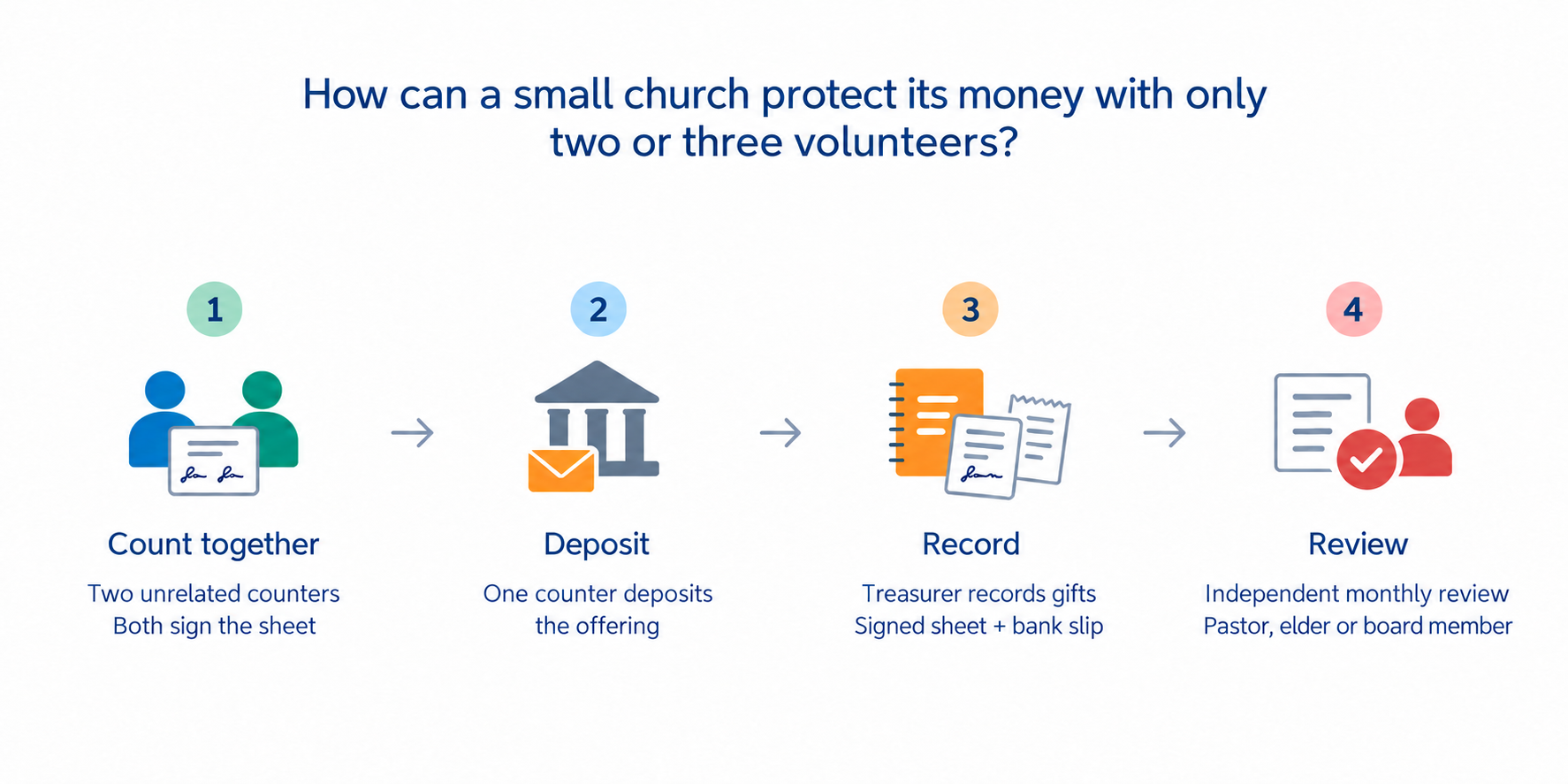
Firstly, the duties can be divided amongst volunteers in a way that no individual has the opportunity of handling money during the transfer process or while recording it.
Here is how this minimalist model can work for a small number of staff:
-
Two unconnected people should do it together, signing the counting sheet.
-
One of the individuals will then go to the bank.
-
The treasures will record the donations using the bank receipt and the counting sheet.
-
Someone who doesn’t have accounting duties - a priest, a board member, or an elder - should check the bank statement at the end of the month.
In such cases when only two persons are available, they should swap responsibilities every couple of days and let the pastor check the bank statement monthly.
This approach will ensure that no single person could steal money from the church without leaving a well-documented trail of who performed various actions.
Parallels Between Church Treasurer and Church Financial Secretary
|
Role |
Main job |
|
Church Treasurer’s Role |
In charge of approving and executing payment, along with overseeing financial records and presenting them to the church board. |
|
Financial Secretary Role |
Taking charge of cash donations and making sure there is an accurate record of donors. |
|
Role of Bookkeeper or Accountant |
Responsible for the maintenance of church accounts and generation of related statements, which requires oversight from the treasurer. |
These roles are often combined in small churches. When the same person fulfills two of them, bring in an independent reviewer. To find out how these roles connect to larger church administration, read about what church management entails.
Qualities of a good church treasurer
The fundamentals of a successful church treasurer are honesty, accuracy and openness to auditors.
-
Integrity: means the church funds should never be confused with the private funds of the treasurer.
-
Accuracy: implies fixing minor problems when they still are minor.
-
Discretion: means the church does not disclose information on donations.
-
Clear communication: signifies that the reports should be easy to understand for the majority of the people with no accounting background.
-
Openness to review: a second pair of eyes is welcome
You do not have to have a degree in accounting, though you do have to know at least the basics of bookkeeping.
Scripture points the same way. Paul wrote that stewards must be found faithful (1 Corinthians 4:2), and that the church should aim to be honourable before people as well as before God (2 Corinthians 8:21).
Does software simplify the work of the treasurer?
It can make record-keeping easier but cannot eliminate the importance of human representatives that are in charge of controls.
This is how Tabernacle assists treasurers:
-
Similar to how donations and tithes are tracked
-
Fundster generates reports fund by fund
-
Donor receipts can be produced using Fundster
-
Main reports for board meetings can be made with Fundster.
When choosing between different types of software, have a look at our guide on church accounting software.
FAQ
What are the four main responsibilities of a church treasurer?
Record gifts, deposit them in the bank, spend only what has been approved, and report back to the church. Monthly bank statements and individual fund records are part of being effective in all four.
Who is responsible for the finances of the church?
The responsibility is on the entire leadership team. The treasurer lays down the day-to-day operations, board or finance committee approves the budget, and the congregation learns about the results. No one person should handle everything.
Is it appropriate for the pastor to be handling the finances of the church?
It is appropriate for the pastor to help in every step of forming the budget and approve spending, but should not do it alone. Having others involved in counting, depositing, and bookkeeping allows the pastor to avoid suspicion and devote time to preaching. Check what your church’s constitution states regarding how finances should be handled.
How do church treasurers and financial secretaries differ?
The financial secretary is responsible for the intake of funds: he or she receives, counts and records the gifts that a church receives. The treasurer handles the outflow of funds that must be spent or used. In churches with limited finances, these two positions may sometimes be performed by the same person.
What are the traits of an effective church treasurer?
Openness is the main requirement for the person who is to be a treasurer. An effective treasurer should be detail-oriented and discreet, able to interpret numbers in simple words and cooperative enough to let someone check his/her work.

Church Treasurer Handover: Why Every New Treasurer Starts From Scratch
Most church treasurer handovers fail because records live in one person's head. Here's what actually needs to change ha…

How to Keep Church Giving Records Accurate
Most giving record errors don't happen because of bad software. They happen in the counting room. Here's where accuracy…

What Changes When Your Church Switches to Church Software
Thinking about moving off spreadsheets and notebooks? Here's exactly what changes in the office, the finance team, and …
