
Church fund accounting: track money by purpose
Church fund accounting tracks every gift by the purpose it was given for. Learn how funds work, how to set them up, and how to read a month of church books.

Suppose a church receives ₹84,000 (roughly US$ 1,000) on Sunday. Some of it is scheduled to go toward construction, some to missions, and the rest to running the church. By Monday the bank balance reads one thing, but the treasurer has to be able to respond to that very common question: OK, how much do we have for spending, and for what? This is what fund accounting provides.
Church fund accounting is how a church keeps track of its money by purpose. The church tracks its income and expenses by each fund. Funds might include general, building, or missions, for example, each fund has its own amount of income, amount spent and remaining fund balance.
Below, you'll see a sample Sunday offering, a fund card you can copy, and a month of sample books. All dollar amounts are estimates, mainly in Indian rupees. The examples illustrate general rules for fund accounting, but specific requirements may differ by country.
What is church fund accounting?
Church fund accounting is a type of bookkeeping that documents a church's income, expenses, and balances according to purpose. When you receive a gift, it's given to a particular fund, for example, a building or a mission, and every expense is charged to the fund it's associated with. That displays what fund is available, not just the total amount.
A fund is not a bank account; it's simply a record of what you've entered into your books. Your bank balance shows the amount of cash that a church has. Fund accounting shows what the cash is for.
It also impacts the questions you'll raise:
A church needs to track not just how much money it has, but, perhaps more importantly, whether restricted gifts have been spent in accordance with the donor's direction.
-
Some gifts may have restrictions or purpose, entered on the envelope, in an online form or pledge card.
-
The board wants to know what remains for each use, rather than just the total.
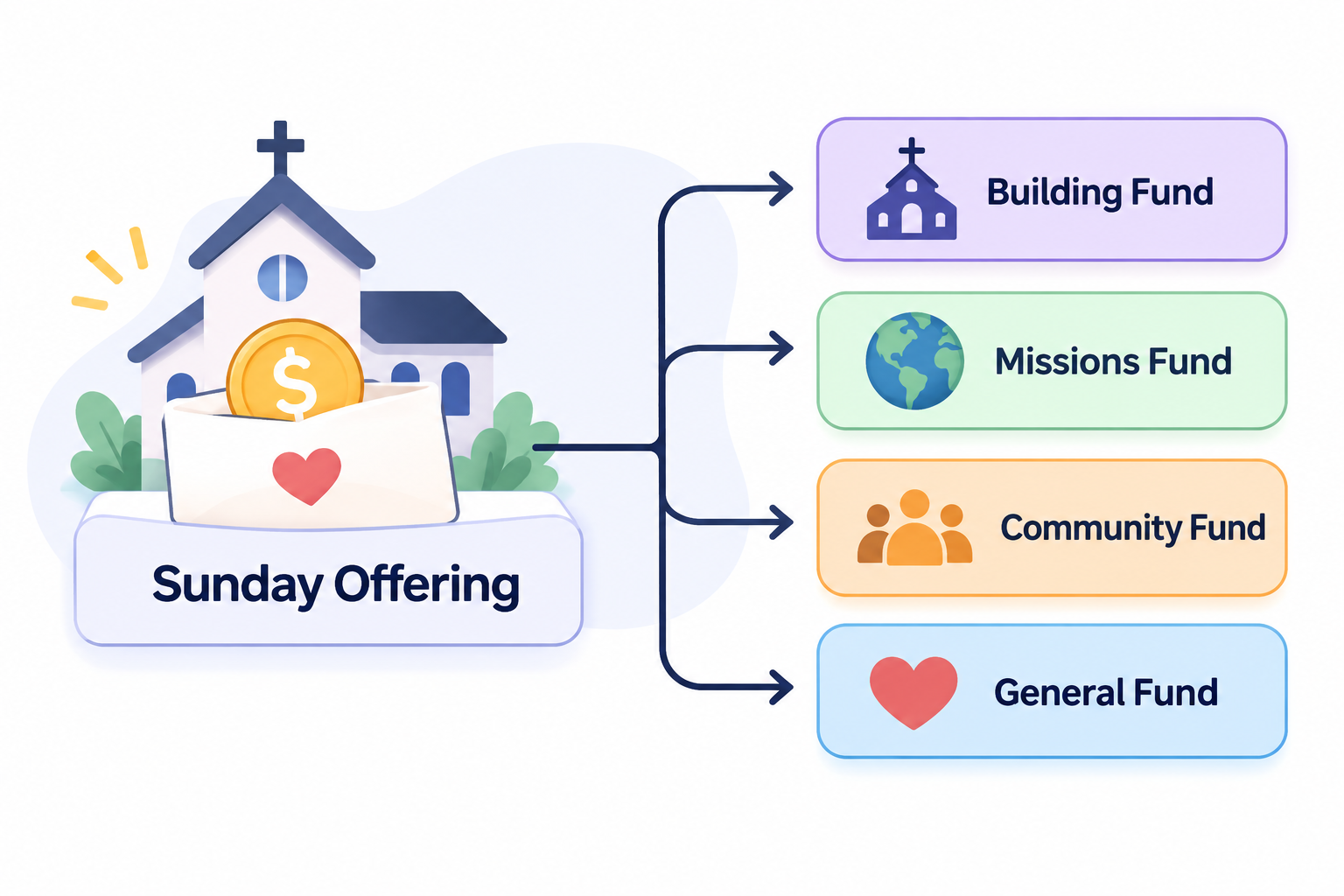
The Sunday offering test: how one deposit splits into funds
The Sunday offering test: how your one deposit is divided into funds
Return to that ₹84,000. This is where it is to be directed. The church and amounts are fictitious for the sake of example. Suppose the donors have set aside the designated gifts to be used solely for the indicated purposes.
|
Gift |
What was written by the giver |
Fund |
Free to spend on whatever? |
| Gift
Tithes for₹52,000 and general offering |
What was written by the giver
No particular restriction |
Fund
General |
Free to spend on whatever?
Yes, within the budget |
| Gift
₹18,000 in respective envelopes |
What was written by the giver
Building fund |
Fund
Building |
Free to spend on whatever?
No, only for permissible building related expenditure |
| Gift
₹ 9,000 in envelopes |
What was written by the giver
Missions |
Fund
Missions |
Free to spend on whatever?
No, only for missions expenses |
| Gift
₹ 5,000 in gifts |
What was written by the giver
Families in need |
Fund
For charity |
Free to spend on whatever?
No, only for helping families in need |
The bank says they deposited ₹84,000. Out of this, ₹52,000 is for expenses to be incurred for payment of staff salaries, expenses for electricity bills and other general expenses, provided the necessary restrictions are observed'. The other ₹32,000 is doing a job.
Keep that gap. We'll keep an eye on it for an entire month.
What types of funds does a church need?
Most churches can probably get by with only three main categories of funds to get started for a practical fund tracking.
-
The general funds are simply money that is not designated for a specific work of the church.
-
Donor-restricted funds are gifts that donors have restrictions as to the purpose or end time.
-
Board designated funds are funds the board has elected to retain from the general fund. These funds aren't restricted, because it's the church that is designating them and not the donor.
|
Fund Type |
Who sets the limit? |
Can the board change it? |
Example |
| Fund Type
General |
Who sets the limit?
No restrictions.The church has the authority to control expenditure within the framework of its mission and budget. |
Can the board change it?
Yes, within their governing rules and in accordance with its authorised procedures. |
Example
Tithes and general offering |
| Fund Type
Donor-restricted |
Who sets the limit?
The giver |
Can the board change it?
Not unilaterally. The restriction terminates when the purpose is achieved or expires. Other modifications require donor approval or legal endorsement. |
Example
Gifts marked as "Building" |
| Fund Type
Board-designated |
Who sets the limit?
The board |
Can the board change it?
Usually yes, by means of a record resolution. |
Example
A roof repair reserve |
Launch your church into the future
Everything your ministry needs — giving, events, members, and more. Try it free, no credit card required.
Start Free Trial No credit card • Cancel anytimeRestricted or board-designated? Ask who set the limit.
No. If the giver directed it, it is restricted. If the board directs it, it is designated from the church's otherwise unrestricted funds.
That one question will dictate the next step. A board may be able to reclassify its own status with a recorded resolution but you may be subject to additional rules in your constitution or bylaws. A board can't overturn a donor restriction by resolution.
How does US nonprofit accounting classify net assets?
In the accountant or auditor's voice: Net assets Is the term we use for the difference between what an organization owns (assets) and owes (liabilities). For a nonprofit organization they are often separated into what donors restricted when they provided assets.
US nonprofits have been reporting two classes instead of three since the FASB ASU 2016-14 became effective.
|
Before |
Now |
| Before
Unrestricted net assets |
Now
Net assets without donor restrictions |
| Before
Temporarily restricted net assets |
Now
Net assets with donor restrictions |
| Before
Permanently restricted net assets |
Now
Net assets with donor restrictions |
All 2 restricted categories were combined. Board-designated funds are included in "without donor restrictions", since the restriction is established by the board and not a donor. The amounts and details of the board-designated funds must also be disclosed, either on the face of the financial statements or in the notes.
This standard is for organizations that are compelled to produce financial statements in accordance with US GAAP. The eligibility of your church to do this will be influenced by what country you are based in, and your organization's legal structure and reporting requirements. You can read the standard itself in FASB ASU 2016-14.
How to set up church fund accounting in five steps
Guide for church fund accounting in five easy steps
Step 1: Examine your giving forms and envelopes: What options can donors choose or write in, and which should be designated as separate funds.
Step 2: For each fund, compose a fund card (see below).
Step 3: Same titles of funds should be used on all of the offering envelopes, online giving site and your books.
Step 4: Determine who approves using the money from each fund. Ensure the approval process is consistent with the reason for the fund and is financially responsible according to your church finances policy.
Step 5: Pick your tools. We list and compare all options below.
The fund card
A fund card is one short page per fund. It answers the questions a new treasurer would ask. Here is one entered for the building fund in our church example.
Fund name: Building fund
Purpose: New hall of the church, construction-related expenditure eligible.
Who set the limit: Donors, as indicated on envelopes and pledge cards.
Spending rules: Only for hall construction costs
Who approve the expenditure: Treasurer and one other member of the board
When to close it: When construction is complete and all Outstanding bills must be paid. Follow the donors' instructions to determine what to do with the remaining balance.
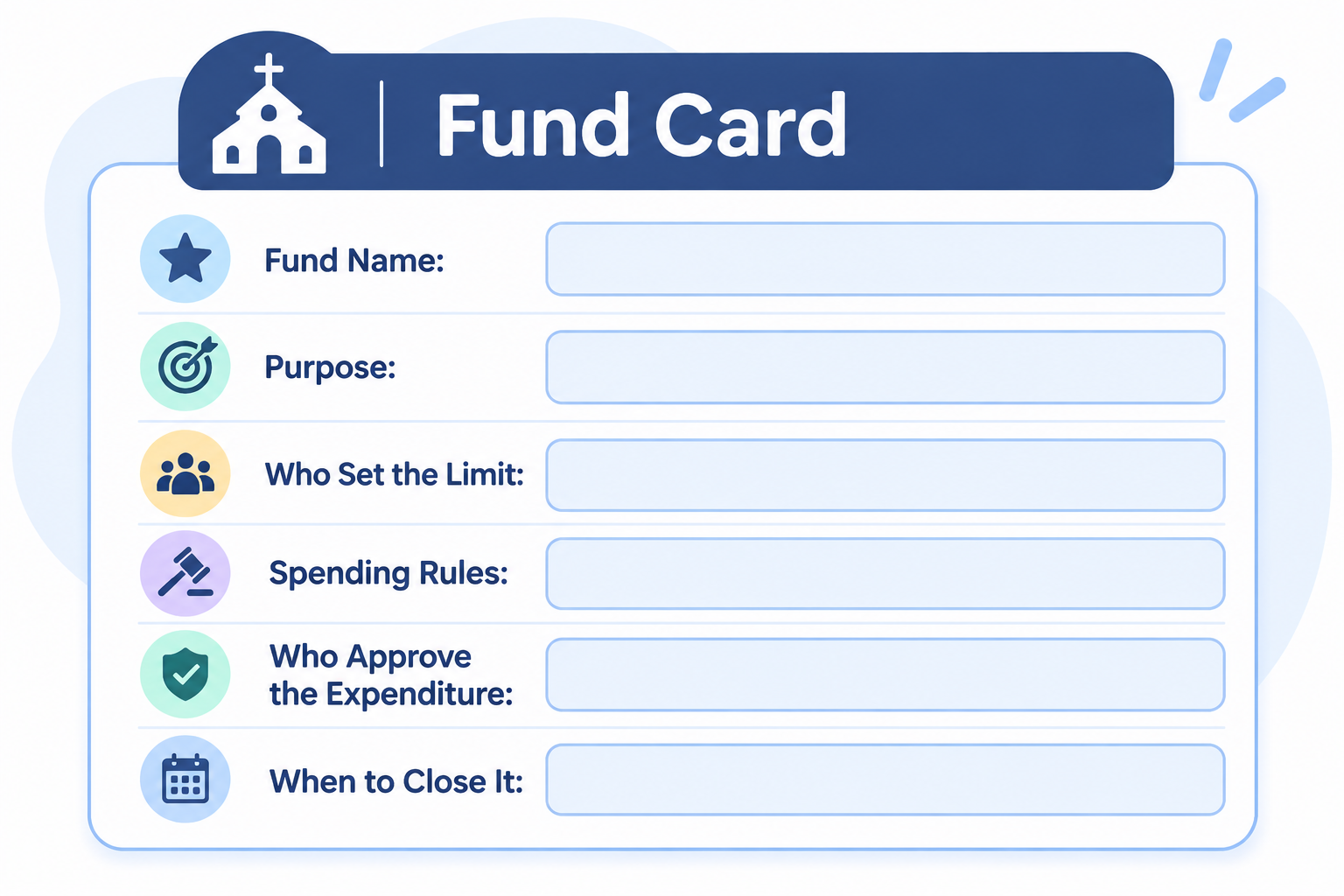 Image 2 (fund card): blank fund card template
-
File name: church-fund-card-template.png
-
Alt text: Fund card template with fields for fund name, purpose, who set the limit, spending rules, who approves spending and when to close the fund
A month in the books: four funds, one ledger
Same example church, four Sundays. Each Sunday is similar to the one above.
|
Fund |
Opening Balance |
Income |
Spent |
Closing balance |
| Fund
General |
Opening Balance
₹1,20,000 |
Income
₹2,08,000 |
Spent
₹2,15,000 |
Closing balance
₹1,13,000 |
| Fund
Building |
Opening Balance
₹3,40,000 |
Income
₹72,000 |
Spent
₹60,000 |
Closing balance
₹3,52,000 |
| Fund
Missions |
Opening Balance
₹25,000 |
Income
₹36,000 |
Spent
– |
Closing balance
₹61,000 |
| Fund
Benevolence |
Opening Balance
₹18,000 |
Income
₹20,000 |
Spent
₹14,000 |
Closing balance
₹24,000 |
| Fund
Total |
Opening Balance
₹5,03,000 |
Income
₹3,36,000 |
Spent
₹2,89,000 |
Closing balance
₹5,50,000 |
It says on the bank statement '₹5,50,000'. The general fund has got '₹1,13,000'. That second number is what the treasurer can plan salaries and bills around. The rest already have a job.
And this is what you see that the bank statement is hiding:
-
Building fund increased by ₹12,000 after paying part of project costs to the extent of ₹60,000.
-
The mission fund received donations but spent nothing, so their account is waiting for a trip or a bill.
-
The general fund expenditures ₹ 7,000 more than what it earned. Month is a note, three months is a pattern.
If there was money transferred between the funds this month, it will get its own line too, so a reader can see it.
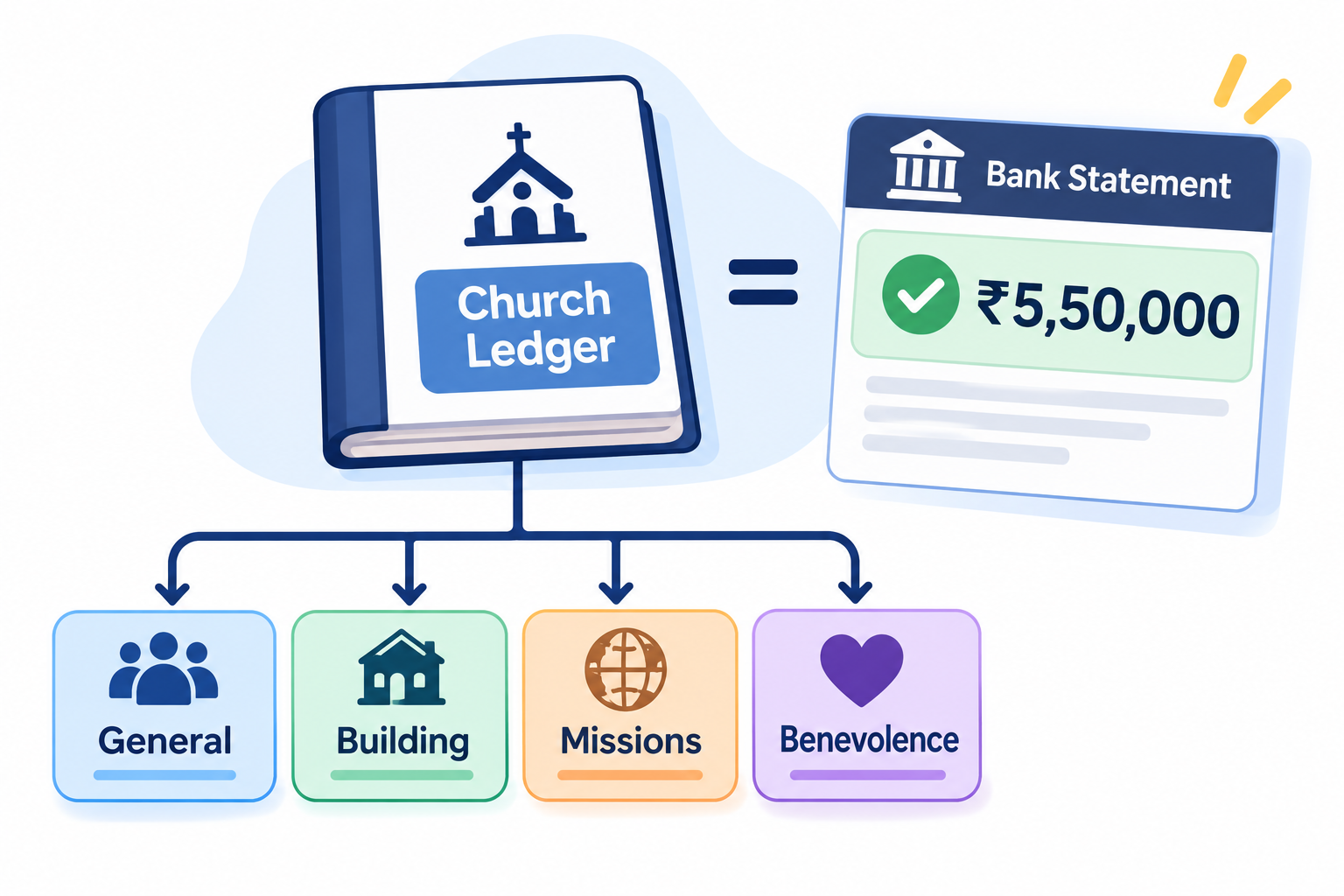 Image 3 (after the ledger): the four balances against the bank balance
-
File name: church-fund-balances-vs-bank-balance.png
-
Alt text: Bar chart showing four church fund balances adding up to a ₹5,50,000 bank balance, with only ₹1,13,000 in the general fund
How do you record donations and expenses correctly?
Ask yourself three questions before sharing anything:
-
Who gave it?
-
What did they say it is for?
-
Who can change that?
Then retain the evidence: the envelope, the pledge card, the online giving note or the board minutes. If a donor or auditor inquires in two years, you want to have something to show for as a record.
When you use the money in the way the donor intends, the restriction is satisfied. A board vote alone cannot release a donor restriction. If a project is not completed, don't take action alone. Read the gift documents, consult your accountant, and speak with donors whenever possible.
Then there's the line that does the most damage: "We'll put it back next week." It seems innocuous. It's how restricted money ends up paying salaries. Think of a restricted fund as a promise, not a loan account.
Spreadsheet, QuickBooks or church accounting software?
The right tool will be dependent upon the number of funds and number of people entering data.
|
Your situation |
What typically helps |
| Your situation
Two or three funds, one person entering data |
What typically helps
A spreadsheet with one column per fund |
| Your situation
Four or more accounts, or multiple people doing data entry |
What typically helps
Standard accounting program where each entry is assigned to a fund (Ex. QuickBooks) |
| Your situation
Many of the funds, online giving, and the monthly reports to the board. |
What typically helps
A dedicated church accounting software such as Tabernacle |
A spreadsheet will serve until it doesn't. The clue is when two people enter the same gift into different columns.
For advice on programs designed specifically for churches, read our guide to church accounting software.
Which reports should you review each month?
There are four things that tell you most of what you need:
-
The balance left in each fund.
-
Balance that is remaining in each donor-restricted fund for its specified purpose.
-
Income and spending by fund.
-
Compare actual spending to your budget for the general fund and any other funds that you have a budget for.
The report we shared on church financial reporting gives you month-by-month what to check and why.
What mistakes should you avoid?
1. Spending restricted money on general costs
What it looks like: the general fund is lacking, but one person is taking money from the building fund "for now."
The fix: Do not move restricted money to meet broad-based costs without the donor's permission and abiding by the rules. If the money is not available otherwise, get it and advise the board early.
2. Making too many funds
What it would be: a discretionary fund for each ministry, event and one-time gift.
The fix: report on a fund only when you will be doing so independently. If you are tracking other activities within a more comprehensive fund, just make sure you don't combine or hide different donor restrictions.
3. One person overseeing every stage
What it looks like: the same person counts the offering, deposits it, records it and reconciles the bank.
The solution: At least some of those jobs need to be divided among two or more people. Here's a post on what a church treasurer is expected to do.
4. Leaving fund rules unwritten
What it looks like: only the old treasurer understands the reasons for the missions fund.
The fix: Write up a fund card for every fund, and leave it where the next treasurer will see it.
5. Ignoring negative or unused balances
What it looks like: a fund that's been in the red for months or no one has opened for two years.
The fix: monitor balances monthly. A fund in the red deserves explanation, even if transferred from another fund. Confirm there were no mistakes in recording, that fund spending did not go over budget, and that expenses were charged to the correct fund. An inactive fund might need a Board resolution. But donor-restricted funds should be spent in line with the donor's intentions.
Do church fund accounting principles differ by country?
It is adaptable: keep track of what money was given for. The requirements don't travel. Different types of churches face different accounting and reporting obligations and there are requirements that come from your country's legal system. Ask a certified accountant in your country what rules you should follow, and use the fund card practice regardless.
Frequently asked questions
What are the basics of fund accounting?
Fund accounting means budgeting by purpose. All donations are allocated to a fund, all expenses are allocated to a fund, and each fund has a balance. Revenue restricted by the donor must be spent according to the donor's specifications.
What are the types of fund accounting?
Most churches have three types of funds: general fund for daily operations, donor restricted fund for a gift a donor placed conditions on, and board designated fund which the board set aside and generally can change.
How to manage church funds?
Open one fund for each reason donors give. Keep track of who established each limit and authorized each expenditure. Record each contribution and disbursement to and from the fund, then compare fund balances to the bank balance each month, and report the comparison to the board.
What is the accounting method for churches?
Churches, the system of accounting structure is fund accounting and then choose cash or accrual for timing. The cash basis recognizes items when cash is received or paid. The accrual basis recognizes items when earned or incurred. Most smaller churches can use cash, but formal GAAP statements require accrual. Ask your accountant.
Ready to transform your ministry?
Join hundreds of churches using Tabernacle — free for 14 days.

Church games: 15 easy ideas for every group
15 easy church games for kids, youth, small groups and adults. Most need only things you already have at home.

Google Calendar integration in Tabernacle
Tabernacle now lets you add your church’s birthdays and anniversaries to Google Calendar with a private link.

Church visitor follow-up: a simple 4-week plan
A small team can follow up with every first-time visitor. Here is a 4-week plan with roles, sample WhatsApp messages an…
