
Church Software for Small Churches: Why It Matters More
Church management software for small churches isn't a luxury - it's the backup system that large churches pay salaries to maintain. Here's why smaller congregations need it more.
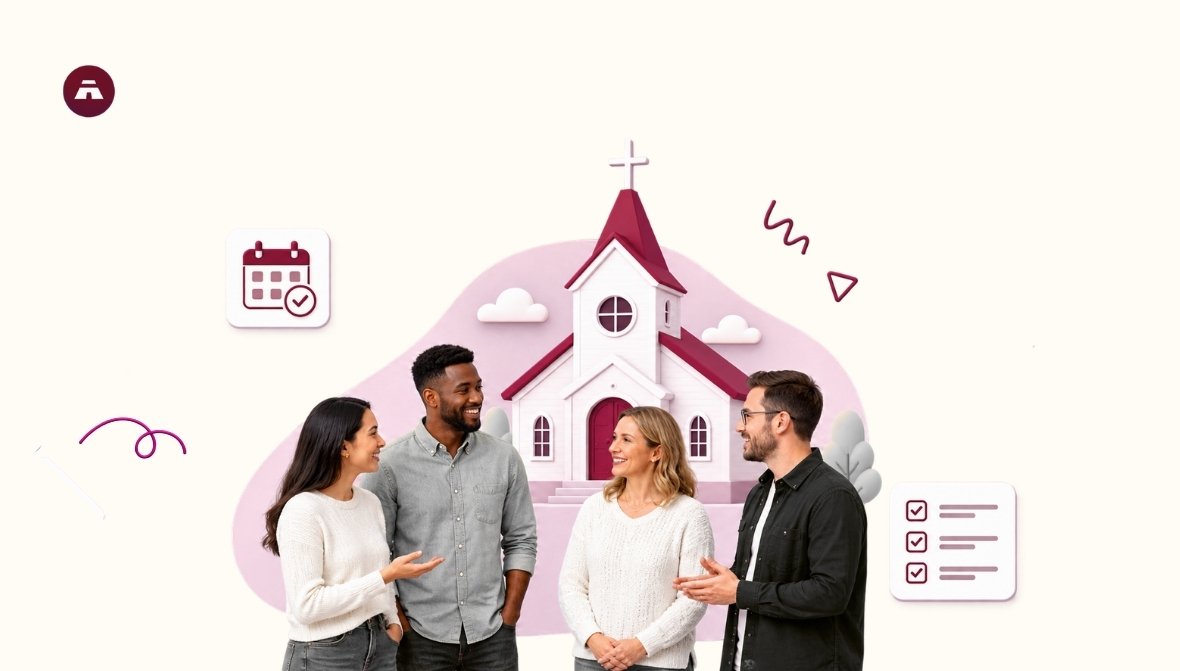
Church management software for small churches is always considered as a luxury, but in reality the smaller ministries are often the one which needs the most.
A megachurch has a full-time administrator, a personal communication team, a dedicated treasurer to manage all the finance, and a person who has the responsibility to keep the data of the member always up to date.
On the other hand a small church might have a volunteer secretary who comes in on Friday afternoons. The treasurer who also leads the youth group and also a teacher to the Sunday school. And the pastor who preaches, visits houses for blessing, visits the sick, counsels - and then comes home to reconcile the last month’s offering ledger before Sunday.
Research from the United Methodist Church shows the average pastor spends 20% of their week - about 10 hours - purely on congregational administration. For a small church pastor doing that work alone, it's often much more.
Larger churches use a church management software because it’s convenient to them. Small churches need it because without a church management software something important will eventually get dropped.
Launch your church into the future
Everything your ministry needs — giving, events, members, and more. Try it free, no credit card required.
Start Free Trial No credit card • Cancel anytimeA Megachurch has an organized staff. A small church has volunteers doing three jobs
An example about this can be when a church member changes their address
-
In a large church: They have a staff assigned for this, so the staff can easily update the database the same exact day.
-
In a small church: The pastor or the volunteers will write it down on a paper, then it will get tucked into a drawer, and then some months later nobody can find the address for Christmas program outreach.
This is not carelessness, it’s a resource problem. The same person handling the records is usually the same person:
-
Preparing the sermon for this week
-
Running the program for the Sunday school
-
Managing the WhatsApp group
A good Church management Software does not force a person to be more disciplined. It will simply shrink a task that took one-hour of administrative chore to a 10-second update.
The effects are higher for a small church
The truth is that the stakes of a poor managed record are actually higher in a small church than a large one.
-
In a megachurch ( 2,000 members): When they lose track of 5 people it is a tiny 0.25% error rate on their spreadsheet.
-
In a small church (150 members): It is totally opposite of a megachurch, losing 5 members basically means losing an entire family, two couples, or an elderly person who stopped coming two months ago because he/she was struggling alone at home.
A small congregation is built on the promise that they are known by everyone. A good church software will ensure that stays true in practice, not just in theory.
A Good member record will always protect:
-
People who have been absent for the past few weeks, before the pastor hears about it secondhand.
-
Tracking those household which has not been visited in over a year
-
Remembering those families that have children reaching confirmation age
-
Being able to pull up every member living in a specific village or a colony when planning a visit
-
Knowing who gave a special offering last Easter, so that you can thank them personally.
You need a consistent system not a complicated software because a paper register that lives in a person’s bag will eventually get lost.
The Treasurer Problem Nobody Talks About
In most small churches, the treasurer is the only person who fully understands how the finances are working. They are the walking encyclopedia of the church’s money:
-
They exactly know the fund for the building project money is sitting in.
-
They know about the difference between a general offering and the collection for a special mission last month.
-
They know which donations are one-time gifts and the regular ones.
The risk is that when the treasure moves away, gets sick, or burns out? All the financial knowledge walks out the door with them.
-
In a large church: They have proper finance committees, multiple backup processes, and multiple accounting staff so that they can cover up the gap.
-
In a small church: The new Treasure will usually inherit a messy folder and a handwritten ledger that nobody else can decode. They have to start completely from scratch.
How can a Church Management Software fixes this:
-
Transparency in logging: Each and every single transaction and donation is safely logged in the cloud.
-
Tracking the fund: The general funds, building funds, and special collections all stay permanently organized.
-
Smooth handovers: When the treasure changes, which the will eventually - the next treasurer can easily log in and pick up everything exactly where the last person left off.
WhatsApp Is Not a Communication System
A small church usually leans on WhatsApp groups because they are free and familiar with it. For a congregation of 40, 40 or 50, it’s genuinely a good choice. But once the church member reaches or crosses 100, 150, 200 members, then the problem will start to show up:
-
An important announcement usually gets buried under 50 unrelated messages
-
Some of the members leaves groups because of notification overload
-
Multiple group being form for different reason and nobody knows which one is the official
-
No official record of who received which message
-
Those elderly members who don’t use WhatsApp will miss the message entirely
Automated Bulk SMS
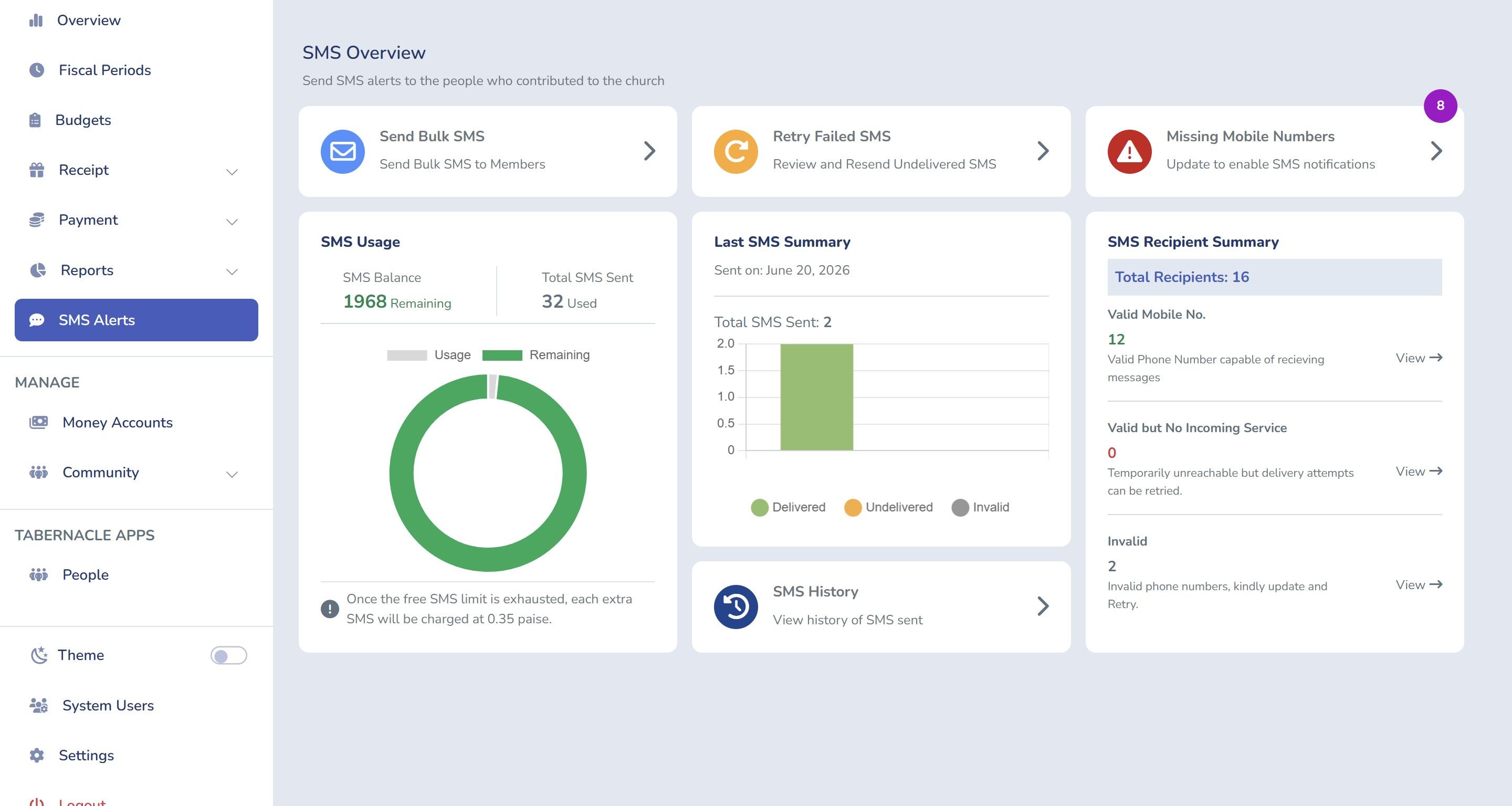
Members give their offering or tithe which gets collected, then a person will usually record all those and then write a small note for the donor - that's a long Sunday.
The person can send a thank you message automatically:
-
No need of writing the message manually by anyone
-
The donor receive the message and gets acknowledged straight away
-
The message lands on any type of smartphone
"We Can't Afford It" Is Usually the Wrong Calculation
One of the main reasons a small church doesn't use a church management software is the “COST”. Which is totally reasonable - every money matters when the church is running on a small congregation’s offerings.
Most of the time the leadership team will miss the hidden expenses
-
The amount of time the treasurer in trying to balance and cross check each paper ledgers manually
-
What will happen when the donor asks for a giving record for the 80G purposes and no one can find it?
-
The emotional and spiritual cost of a family or a member who has left the church quietly because no one noticed they stop coming
-
How much time it costs when a register or a notebook of an administrative task gets lost and the amount of time spent to redo it.
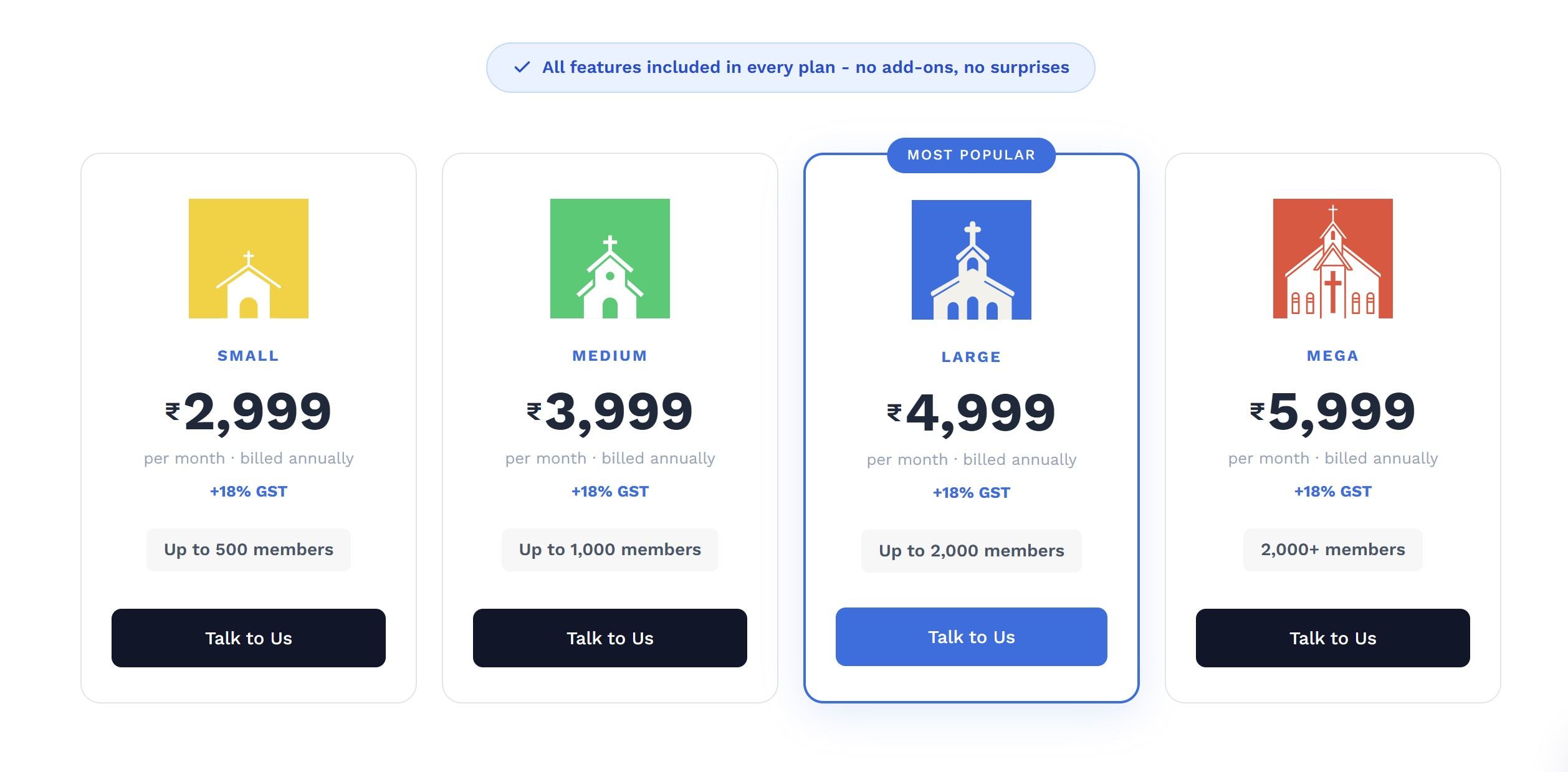
Church software for small churches starts from 29$ or ₹2,999 in India Currency, which is less than what most of the small churches spend on stationary and printer ink. The main question here is not whether you can afford the software, It is how much the current system will cost once you count everything it costs.
Large Churches Have Margin for Error. Small Churches Don't
For small churches the margin for error is much tighter:
-
Finances: A large church can misplace a financial record, and it won’t affect their operation for the coming weeks. But, if a small church miss one donation, then the church treasure will instantly come to know about it because the cash flow for Sunday’s immediate expenses won’t add up
-
Member database & Care: A large church can manage with a disorganized database because they usually have an entire army of staff members to cover the gaps. A small church with a messy database will get lost in figuring out which families have not been visited this year, without wasting time digging through the old paper register.
The administrative error is definitely lower than the larger church, but small churches are the one running on a very fragile system. Software is never a luxury. It’s just that large churches have the capacity to hire full-time staff to manage the admin. That will eventually cost salaries. Most of the small churches can’t do that. Church software does the same job for a friction of that cost.
How Tabernacle Handles Church Management for Small Churches
Tabernacle is built upon how churches actually run, not some adapted software that is designed for larger organizations with full admin teams.
Two areas that make immediate difference for a small church:
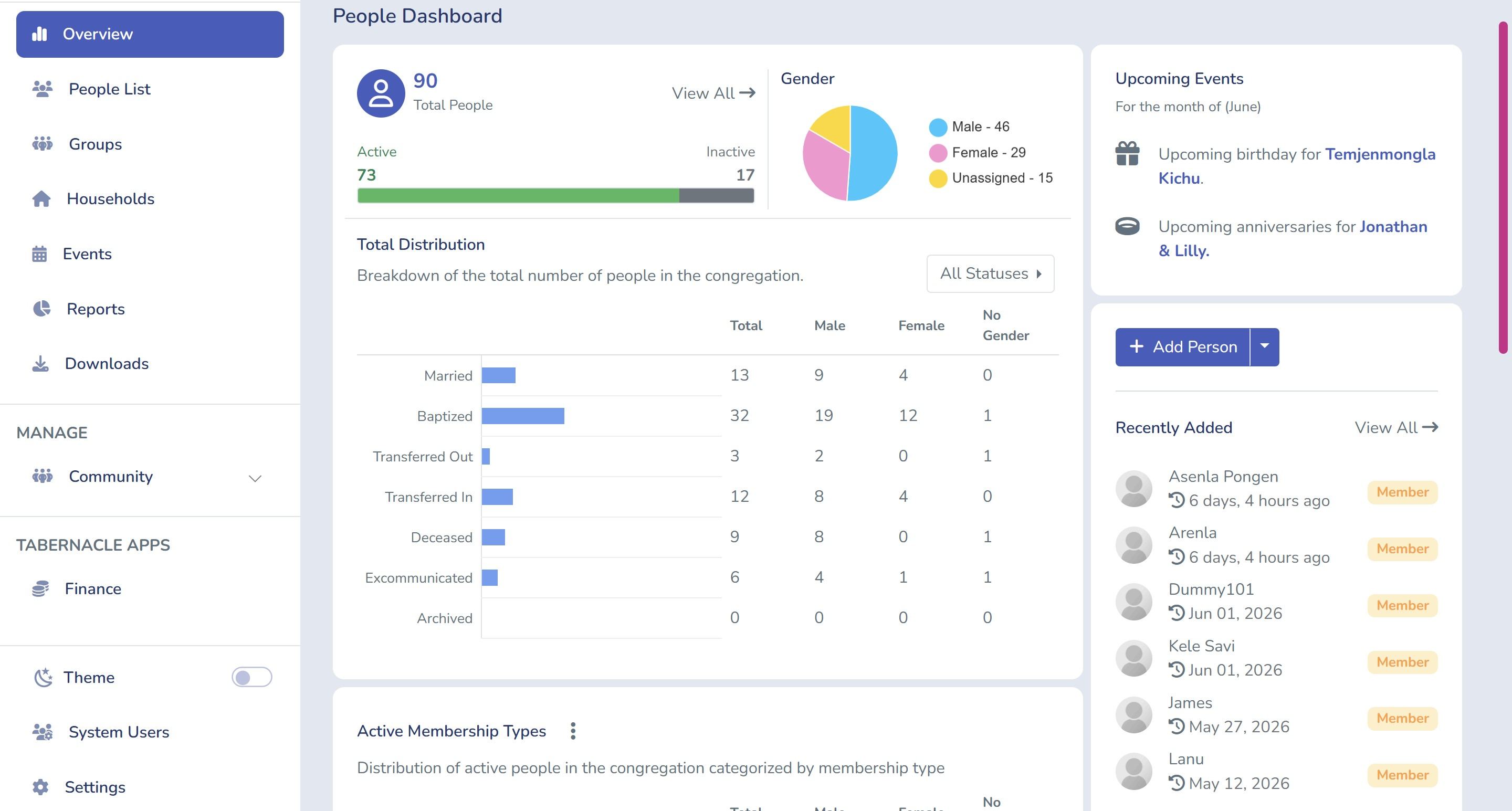
The People Module
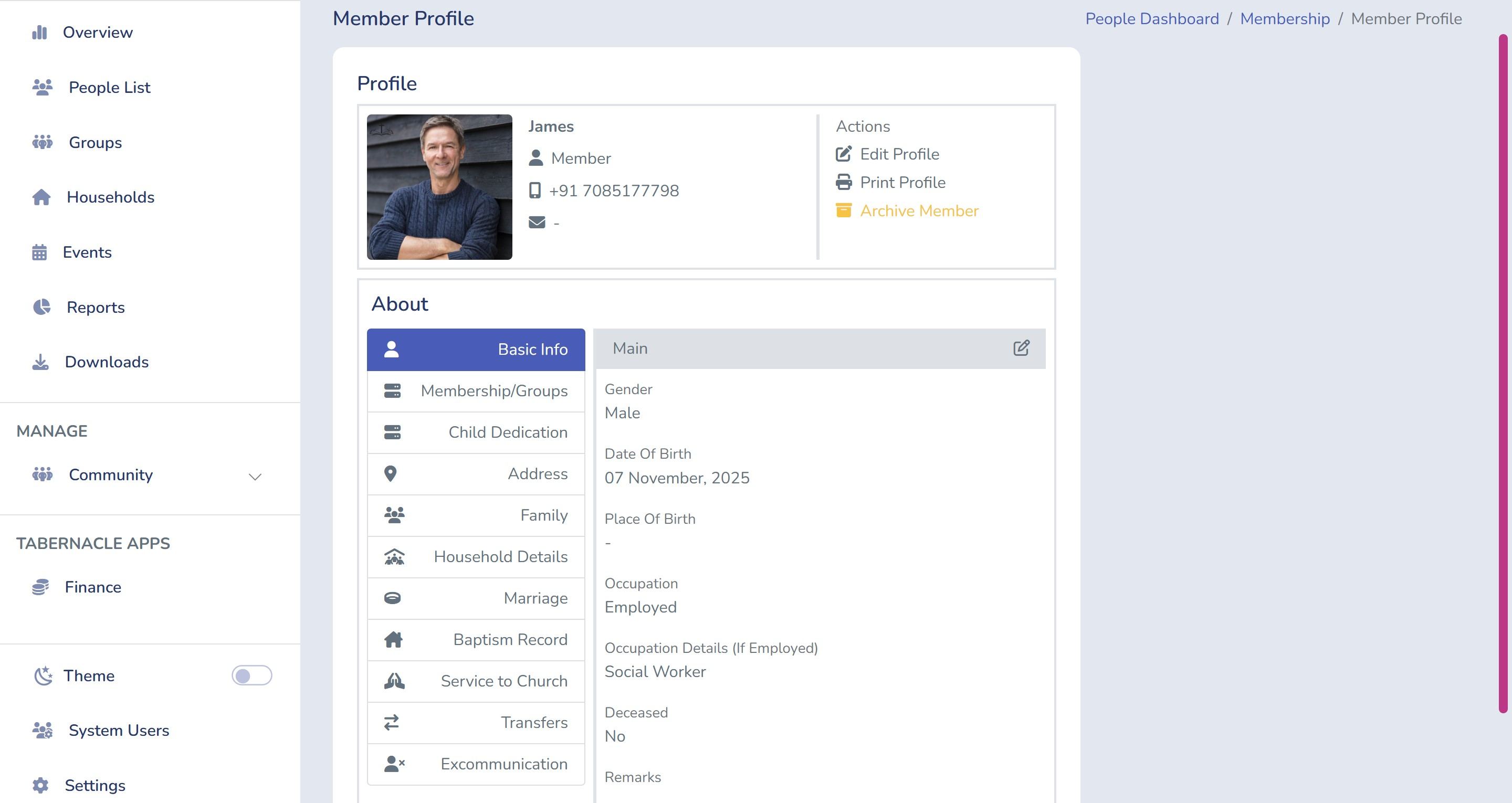
The Members are recorded and organized by household, colonies, village, and fellowship-made in a way most of the churches think about their congregation. Search any member in seconds and get to know their details.
Finance Module
Fund accounting built for church giving - offering, tithes, offering, special donations, mission and building funds - all tracked separately without the requirement of a certified accountant.
When every admin or the treasurer changes, the next person can pick up exactly where it was left off. No starting from scratch or no loss of record.
More than 150 churches are using Tabernacle, most of the churches using our software started with one problem that is the treasurer problem or the member record problem - this problem initially became too hard to ignore.
Frequently Asked Questions
Do small churches really need church software?
Yes, definitely and more than the large churches. No admin staff means no one to catch the errors and mistakes. The software does that job easily.
How affordable is the software for small congregations?
Church software starts from 30$ or ₹2,999 in Indian currency per month - less than most of the churches spending on stationary
What happens if our treasurer leaves?
Nothing changes. The transaction, funds, all the record everything stays and is already documented in the system.
Can the church members use the software too?
They don’t have to. The software is only for the pastor, secretary, and treasurer. The members will be noticing things running smoothly.
How hard is it to switch from Excel to church software?
All the migration process is taken care of by the Tabernacle’s team at no extra cost. All you need to do is to send your existing data.

Duties and Responsibilities of a Church Treasurer
A church treasurer records gifts, banks them, pays approved bills and reports to the church. Here are the seven duties …

Church Treasurer Handover: Why Every New Treasurer Starts From Scratch
Most church treasurer handovers fail because records live in one person's head. Here's what actually needs to change ha…

How to Keep Church Giving Records Accurate
Most giving record errors don't happen because of bad software. They happen in the counting room. Here's where accuracy…
