
Church Budget: A Practical Guide for Churches
Learn how to create a church budget step by step: estimate income, list costs, add a reserve, and check spending each month.

A church budget is a written plan for the money a church is expected to receive and how it will be used during the particular year. A church budget is not a prediction; it is a decision taken by the church about what it will do with what it has been given.
Every church needs a church budget; without one, the expenses will be decided on the day they arrive.
Our guide will walk you through creating a church budget from scratch, with a simple worked example and a monthly check you can run.
Key Takeaways
-
A church budget is a well-planned plan for income and spending, agreed upon before the year starts
-
The church leaders and the financial decision - maker should work on preparing the church budget
-
Estimate a low income, honestly listing the costs, and always set aside a reserve for emergencies
-
The actual spending to be compared with the prepared budget every month
-
Review of the budget on a half-year and tell your congregation if there is any short falls on giving
Why does a church need a budget?
A church needs a budget because it turns the church’s priorities into numbers, helping leaders make informed decisions about spending. It protects the ministries that matter most and helps members understand how their gifts are being used.
Church budgeting differs from planning a household budget in one way. Much of a church’s income comes from donations and offerings, and some of it is given for a stated purpose, such as a building or missions. That makes it even more important to plan where it will go. Our bookkeeping guide explains how funds keep those gifts separate.
In practice, budgets accomplish three objectives:
-
They safeguard the necessities, such as pastoral help and missions, from being depleted by smaller requests.
-
Budgets notify leaders beforehand when income and expenses are diverging.
-
They reveal to the members how their giving is used.
The principle of planning for the future is nothing new. In fact, Jesus said: ‘For which of you, intending to build a tower, does not sit down first and count the cost?’ (Luke 14:28).While this passage is not specifically about modern church budgeting, it illustrates the importance of thinking through the cost before making a commitment . A guide by Stewardship UK deals with different questions many leaders ask, and also who is responsible for budgeting and whether budgeting is biblical.
To better understand how a church handles money. Read our guide on church financial management; it dives deeper into the budget itself.
Who should create the church budget?
Building the budget should preferably be done in a small team instead of giving it all to one person. A typical team will look like this:
-
Pastor - knows about church vision and ministry requirements.
-
Treasurer - knows about church finances and keeps records of the numbers (see church treasurer duties).
-
One or two finance team members who ask practical questions and help with the review.
-
Ministry leaders, who explain their needs, even if they do not participate in all meetings regarding the budget.
The final budget has to be approved by the board or church council. The more people are involved in the planning, the better they will understand the decisions and be supportive in the final budget development.
What are the types of church budgets?
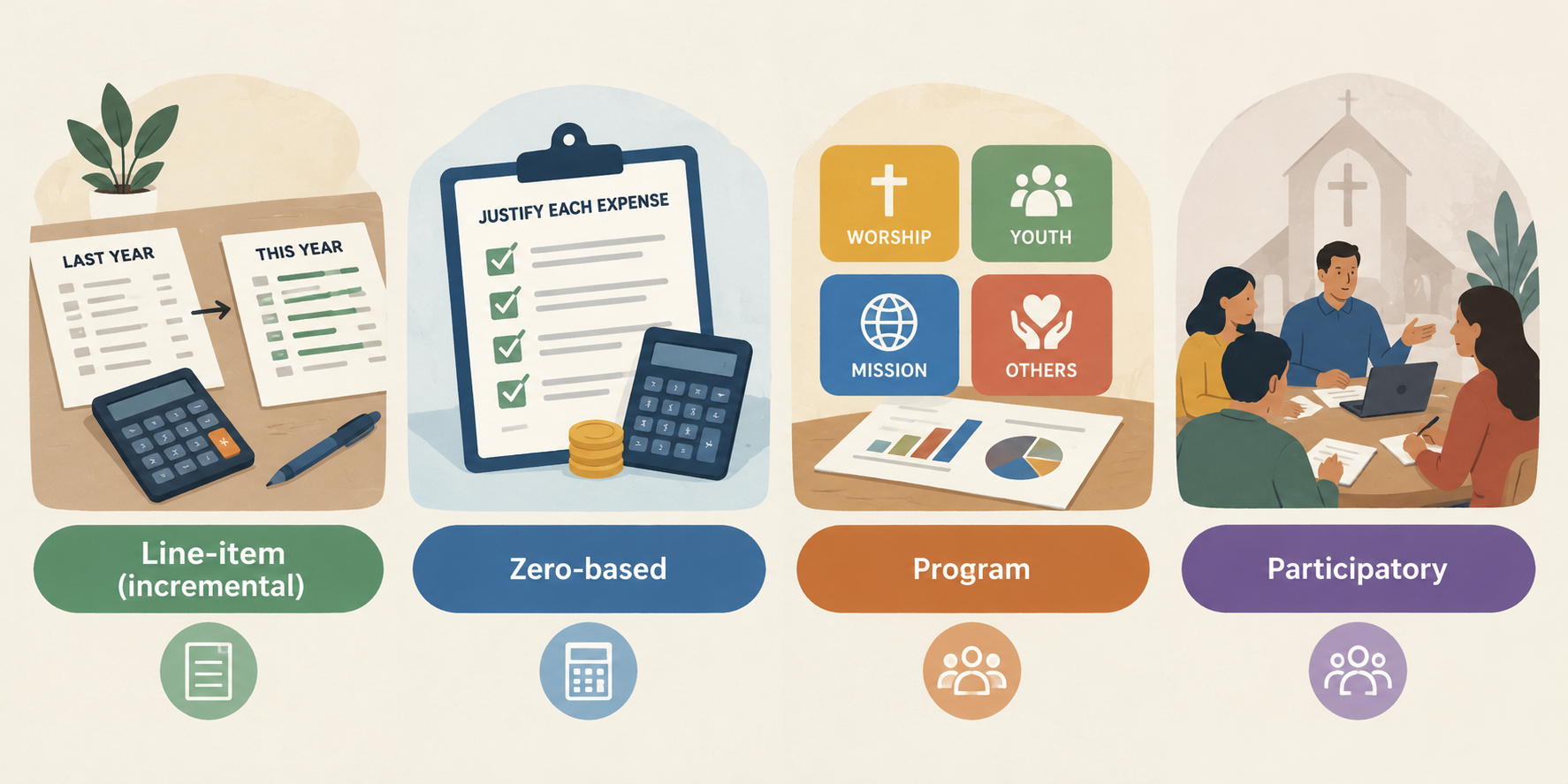
Churches typically have four approaches to budgeting. Each method is a different way of determining what should be included in the plan.
|
Approach |
How it functions |
Best suited for |
|
Line-item (incremental) |
Using the previous year's budget as the basis, the costs for each item can be amended. |
Finances are stable and the desire is to use something straightforward and similar. |
|
Zero-based |
Costs are built up from zero, by justifying all the expenses. |
Costs have increased without clear reasons or the church has developed or evolved in some way. |
|
Program |
Budgeted according to programs (worship, youth, mission, etc.) and analyzed according to the results. |
The church has many active programs. |
|
Participatory |
Involvement of the congregation in planning. |
The church wants to involve its members and ministry leaders in the budgetary process. |
The simplest form of budgeting will be the line-item one. If you note that costs have risen without a reasonable explanation, consider the zero-based approach for the next budget.
Launch your church into the future
Everything your ministry needs — giving, events, members, and more. Try it free, no credit card required.
Start Free Trial No credit card • Cancel anytimeHow do you create a church budget step by step?
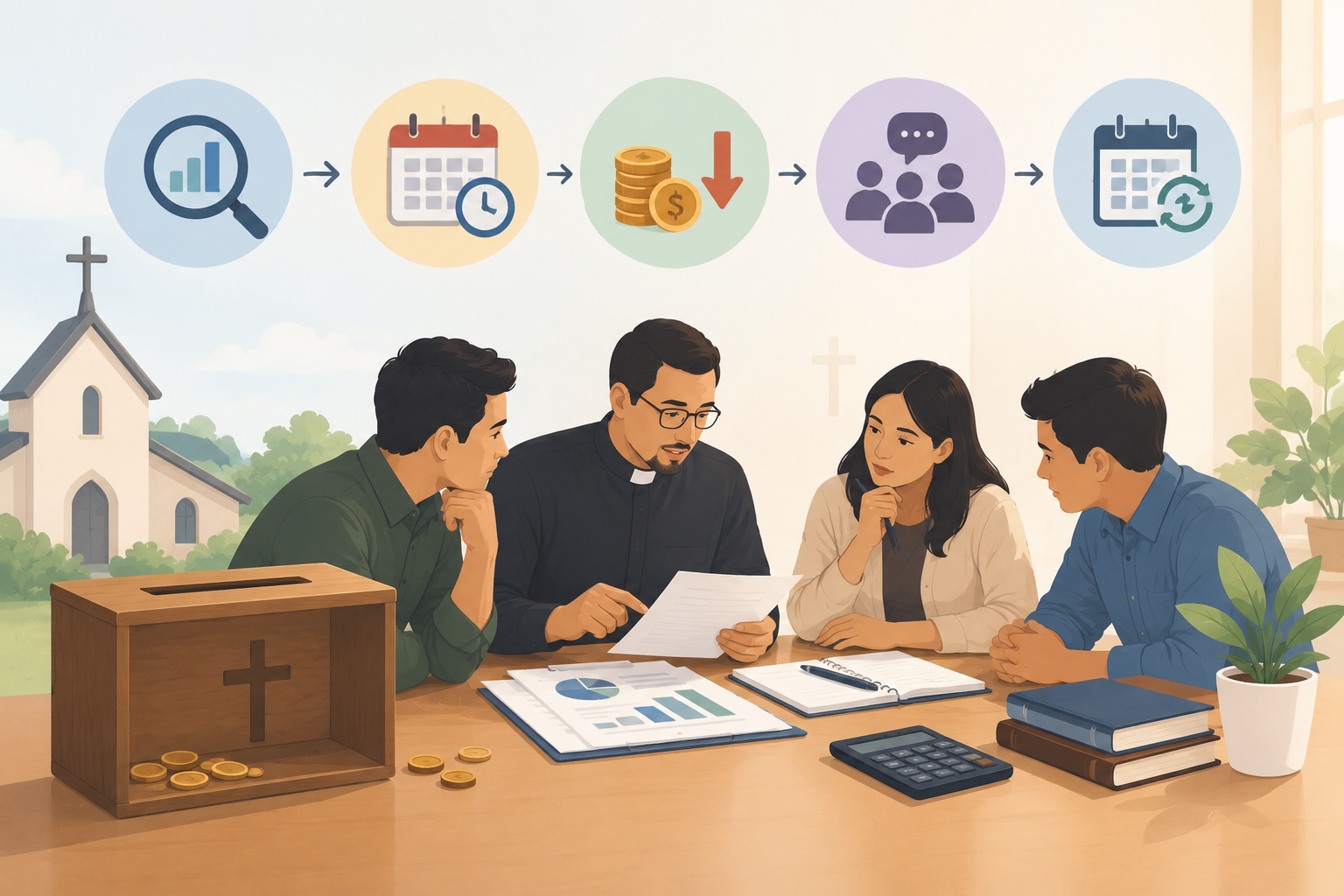
It is important to carry out these six steps in a specific order. It helps you to write down the first draft in one sitting.
Step 1: Analyze your data
The first step you need to take is to prepare a record of all income and expenses for the past twelve months. The data is taken from your bank account transactions, tithe records, and regular utility bills. If you lack data, take available data and mark the information you are missing. Our guide to church bookkeeping for beginners will explain the records you need to keep, so you can use it for the future.
After that, select the appropriate budgeting techniques from the table above. If you are unsure of which budget you are going to implement, you can use line-item budgeting.
Step 2: Assess your total income
Make a list of all sources of income you have. You can mention regular offerings, tithing, and gifts. After that, estimate the income conservatively without assuming that it will be better than the one you had last year.
In Karl Vaters's “Small Church Finances: 4 Budgeting Lessons I Learned the Hard Way,” he explains that churches should be conservative in estimating income. If a church bases its needs on growth that isn’t there, it can lead to tough choices. Being conservative in budgeting means any money that comes in above estimates can be treated as an unexpected bonus. See his four budgeting lessons to get practical tips.
Step 3: Calculate your fixed costs.
The church must budget for these expenses no matter the levels of donations in the given period. These expenses should be divided into two categories:
-
People: salary of clergy, remuneration of staff, and other forms of compensation.
-
Facility: lease payments, costs of utilities (light, water, internet), and other payments, including insurance and licenses.
Step 4: Add up the costs of running the ministries
-
Ministries: costs of equipment necessary for work of the church, youth, children’s, and outreach ministries.
-
Missions and donations: expenses of holding missionary work and providing assistance to people in need within the church community.
-
Administration: costs of printing, bookkeeping, and other office expenses.
After this, move on to costs that are yearly in nature. These costs may often be ignored, such as:
-
Building repairs and maintenance costs.
-
Annual events and conferences.
-
Equipment that will need to be replaced.
Step 5: Create a reserve
Put small amounts of money into a reserve each year. It may seem small, but having a reserve will help your church pay for a broken pump or a bad month without cancelling ministry. If your church has thought of any construction project, allocate an additional amount of money for this project.
Step 6: Prepare, approve and share the budget
Add income and expenses. The budget should balance, meaning planned costs must equal the income or leave a little surplus. In case there are more costs, go through the budget again and reduce costs, starting with those expenses that can wait. Then, present it to the church council and get approval. And share a one-page summary with the congregation.
Now that we've covered the basics, let's check out an example budget, as well as figure out how to deal with potential problems as they arise during the year.
What does a sample church budget look like?
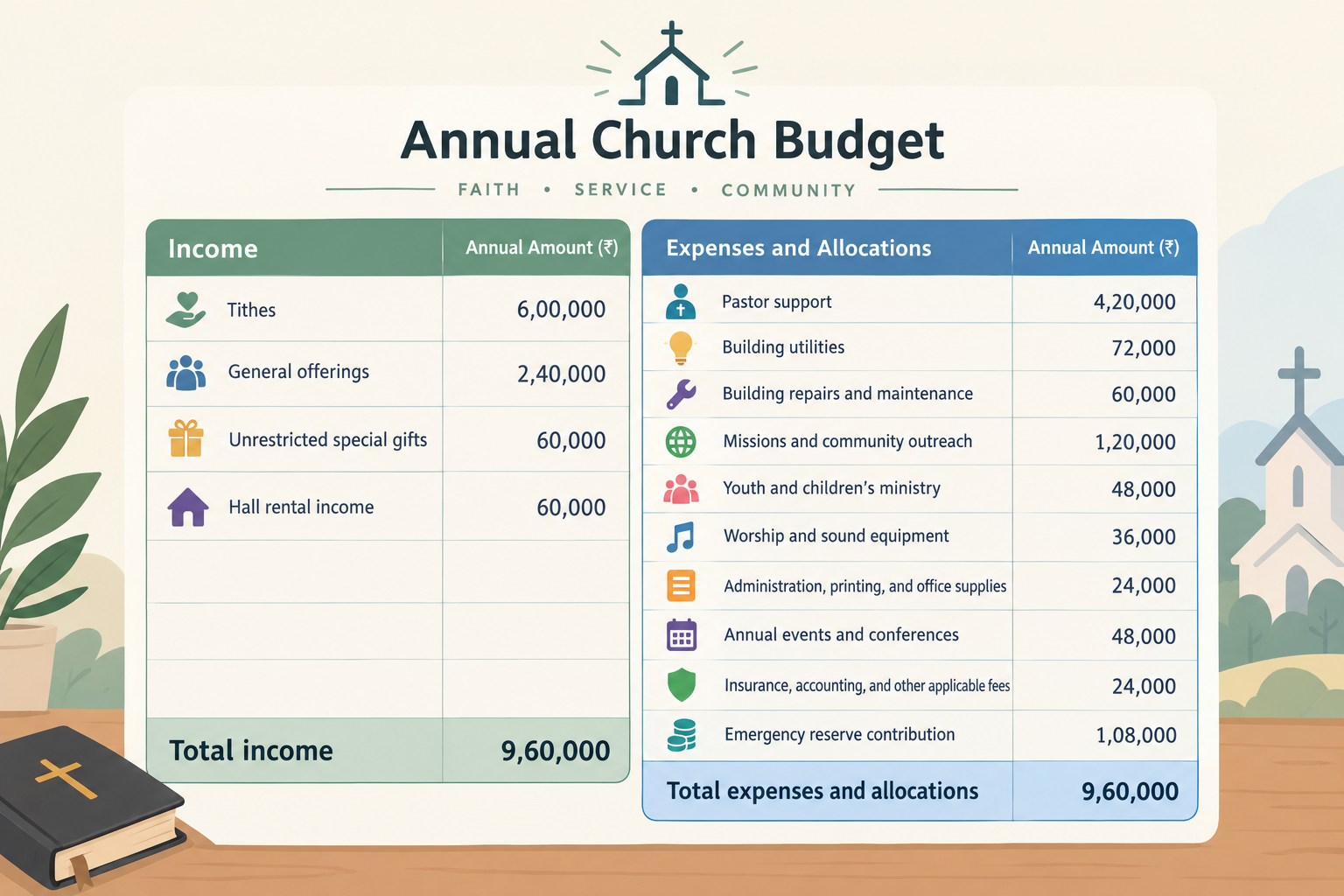
The following is an example of an annual budget for a church with a congregation size of around 80. The figures provided are for sample purposes only.
|
Income |
Annual amount (₹) |
Expenses and allocations |
Annual amount (₹) |
|
Tithes |
6,00,000 |
Pastor support |
4,20,000 |
|
General offerings |
2,40,000 |
Building utilities |
72,000 |
|
Unrestricted special gifts |
60,000 |
Building repairs and maintenance |
60,000 |
|
Hall rental income |
60,000 |
Missions and community outreach |
1,20,000 |
|
Youth and children's ministry |
48,000 |
||
|
Worship and sound equipment |
36,000 |
||
|
Administration, printing, and office supplies |
24,000 |
||
|
Annual events and conferences |
48,000 |
||
|
Insurance, accounting, and other applicable fees |
24,000 |
||
|
Emergency reserve contribution |
1,08,000 |
||
|
Total income |
9,60,000 |
Total expenses and allocations |
9,60,000 |
📌Note: This example assumes that the listed income is available for general budgeting. Donations restricted to building projects, missions, or other specific purposes should be tracked separately and used according to their restrictions.
The reserve has its own line, and the repairs have a line as well, resulting in totals. In the case of each expenditure, it is assigned to one of the categories in Steps 3 through 5. This makes the budget easier to compare year to year.
What if the church does not have any giving history?
Begin with modest assumptions and minimize your estimates. For example, if you’ve only been keeping records for a few months, use those months to project income for the rest of the year, considering seasonal effects or notable events that may affect the results. Do not just assume that contributions will increase or decrease at certain months for no reason. Treat the budget as a rough draft and review it three months later. Then compare your actual income and expenses with your estimates and adjust the budget accordingly.
How do you track the budget through the year?
A budget is valid only if it is monitored. At least once in a month, compare the budgetary projection and the actual outcome. The table below shows an example of what this could look like after three months.
|
Line |
Budget for 3 months (₹) |
Actual (₹) |
Difference |
|
Tithes |
1,50,000 |
1,38,000 |
₹12,000 below budget |
|
Utilities |
22,500 |
26,000 |
₹3,500 over budget |
|
Repairs and maintenance |
20,000 |
8,000 |
₹12,000 under budget |
|
Missions and outreach |
40,000 |
40,000 |
On target |
📌Note: These figures are for illustrative purposes only. The actual earnings and expenditures may differ substantially depending on church size, location, activities, and financial situation.
Next to each of the differences, write one sentence with the reason for the difference. For instance, lower donations may be caused by seasonal reasons, while higher utility bills mean that there has been higher consumption. One month of unusual figures does not make it automatically a problem; however, two months should stimulate investigation.
Proper records of giving can also help maintain proper records of income. How to do this is discussed in our article on how to keep church giving records.
What should you do if giving falls short?
Avoid waiting for the calendar year to end; go through the following points:
-
Determine if the cause has to do with timing or if there’s a longer-term problem. Certain months may see lower donations.
-
Postpone any not-so-urgent expenditures, such as repairs and new equipment.
-
Examine the unnecessary expenditures in detail prior to laying off employees or reducing the level of the core ministry.
-
Explain to your congregation in plain language what changes occurred and what is planned.
-
Go through the budget again at mid-year since you shouldn’t postpone handling the issue until the financial gap becomes greater.
Timely, truthful updates enable church leaders to act before issues escalate and provide members with more insight into the financial health of the church.
What mistake should you avoid?
-
Estimating income at an artificially inflated figure as compared to last year's income without justification.
-
Ignoring annual expenses and being surprised upon their arrival.
-
Having zero reserves.
-
Creating the budget in isolation.
-
Setting the budget then ignoring it in the future.
FAQs
What should a church budget consider?
A church budget must outline potential revenue, expenses related to operations and ministry work, annual expenses, as well as a contingency budget.
How can you draw up a budget for your church?
Start by studying historical data, conservatively predicting revenue, recording expenses, and leaving some funds for contingencies.
What are different kinds of church budgets?
There are three prevalent methods for budgeting: itemized budgeting, zero-based budgeting, and program budgeting. Different combinations can also be applied.
What does the Bible say about church budgeting?
The Bible encourages people to conduct thoughtful planning and management of funds. For example, Luke 14:28 emphasizes the necessity for making calculations in budgeting, whereas Proverbs 21:5 promotes the meaning of planning in advance.
How often should a church get its budget reviewed?
Make monthly evaluations and initiate a detailed review halfway through the year. Revise the budget if there are significant changes in revenue or expenses.
Ready to transform your ministry?
Join hundreds of churches using Tabernacle — free for 14 days.
Jesus quotes: 25 sayings and what they mean
25 Jesus quotes from the Gospels, grouped by famous, love, hope, faith and short sayings, each with its Bible reference…

Church Bookkeeping Made Simple for Beginners
New to church bookkeeping? Learn what to record, how to track funds, and a simple monthly routine that any new treasure…
Church Administration: Building an Organised Ministry
Church administration covers records, money, people and meetings. See who in your church handles each part.
